


Alberta's United Conservative Party government has introduced sweeping new legislation aimed at stripping what it calls political ideology from the province's classrooms — a move that has drawn both praise from parent advocates and sharp criticism from educators and opposition politicians.
Education and Childcare Minister Demetrios Nicolaides tabled the bill, formally titled An Act to Remove Politics and Ideology from Classrooms and Amend the Education Act, 2026, in the legislature on Tuesday. The legislation would prohibit teachers and school boards from making political or social statements deemed outside their mandate, restrict schools to displaying only the Canadian and Alberta flags — with possible exemptions — and give parents greater input into their children's education.
The bill also establishes conduct principles for school trustees and requires ministerial approval before any school building can be named or renamed.
"Teach Students How to Think, Not What to Think"
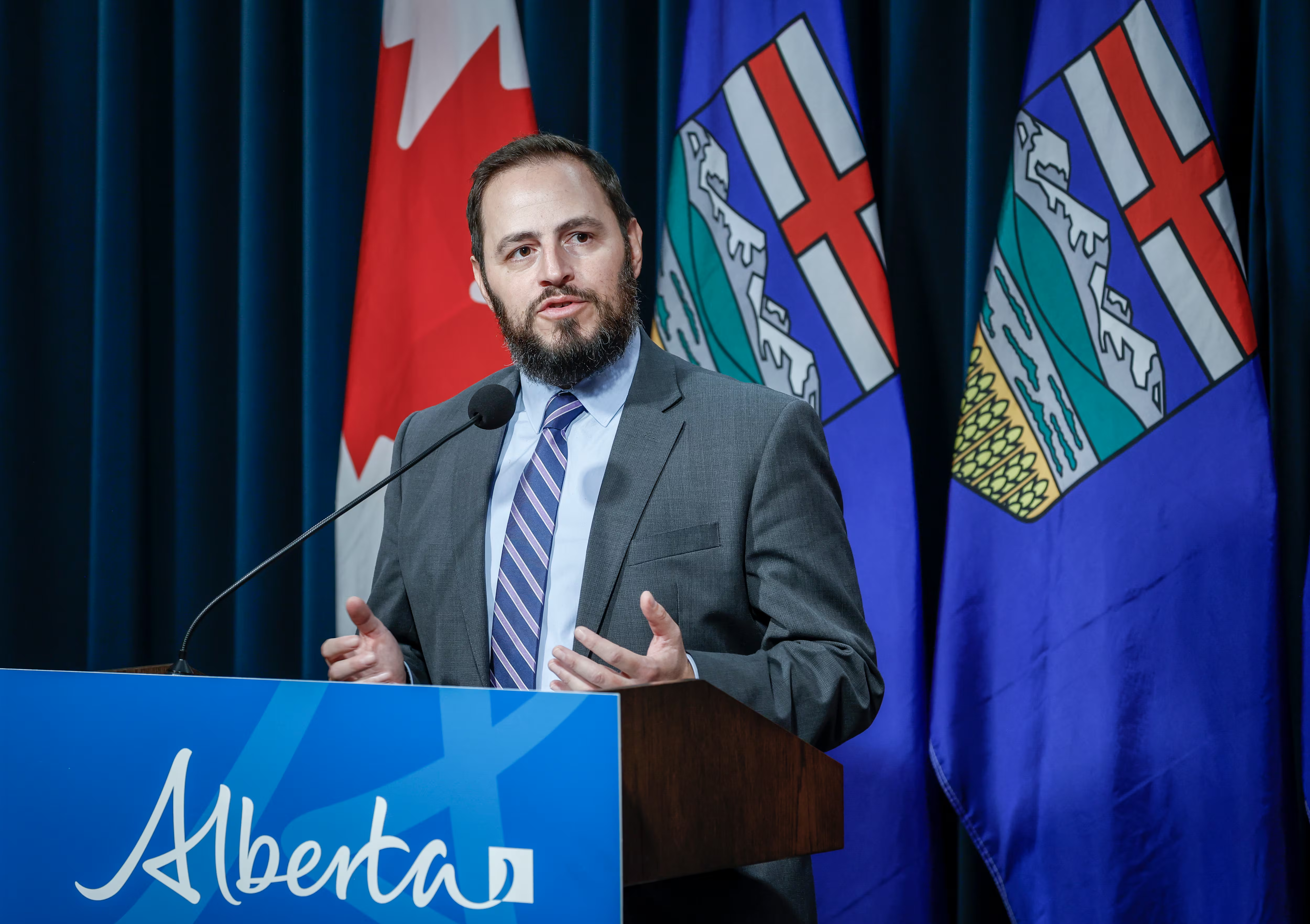
Speaking at a press conference Tuesday, Nicolaides framed the legislation as a return to impartiality in Alberta's public education system.
"This bill reflects that schools should teach students how to think, not what to think," he said, adding that classrooms must be neutral learning environments where no single political position is elevated above others.
Premier Danielle Smith's government has moved repeatedly in recent years to establish what it describes as guardrails for Alberta youth in publicly funded schools. In 2024, the province amended the Education Act to require parental opt-in before students under 16 are taught about gender identity, sexual orientation, or human sexuality, and mandated guardian notification regarding preferred pronouns and names for minors.
Last summer, Nicolaides announced that schools must remove materials identified as explicit sexual content from classrooms and libraries. That directive came during a bitter labour dispute with Alberta's 51,000 public school teachers, who walked off the job for three weeks before the UCP government invoked the notwithstanding clause to pass back-to-work legislation. The book-removal policy faced broad criticism and was later narrowed to target only visual depictions of sexual acts.
Educators Warn of "Chilling Effect"
Not everyone sees the new bill as a straightforward defense of educational neutrality. Carla Peck, a professor of social-studies education at the University of Alberta, warned the legislation could instil fear among teachers — particularly those in subject areas where current events and social questions are core curriculum.
"This will have a chilling effect on teachers, especially social-studies teachers," Prof. Peck said. "Teachers will be very nervous about what they're going to be allowed to say or use as materials or bring up in the classroom."
Peck characterized the bill as a broader attempt to silence progressive perspectives within Alberta's school system, arguing that the vague language around "ideology" leaves far too much room for interpretation — and intimidation.
NDP Says Problem Is Manufactured
Alberta NDP education critic Amanda Chapman questioned the very premise of the legislation, saying ideological imposition by teachers is not a concern she hears from parents across the province.
"It's not at all clear to me what is meant by ideology, and what ideology it is exactly that the minister is trying to scrub from our schools with this legislation," Chapman said, adding that Alberta schools already offer balanced perspectives to students.
The bill signals the Smith government's determination to shift public education back toward core academic fundamentals — reading, writing, mathematics, and critical thinking — while limiting what it views as the creeping politicisation of curricula. Whether that vision aligns with the realities of modern teaching, or whether it will suppress legitimate classroom discussion, remains a central point of contention as the legislation moves forward.
Source: The Globe and Mail. Original reporting by Samantha Goldstein.