


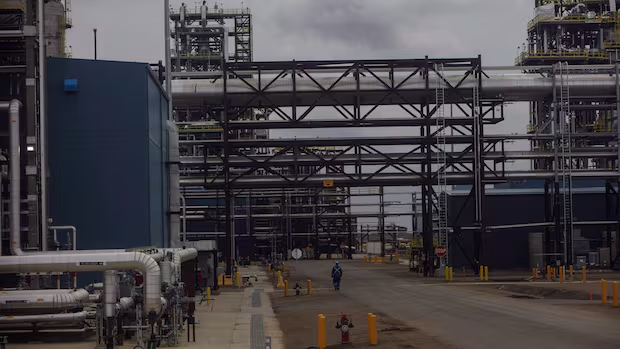
Alberta's oil sector remains firmly positioned to compete in global markets despite a new U.S. agreement to access Venezuelan crude, Premier Danielle Smith said Tuesday.
Speaking at a Calgary news conference, Smith emphasized that Alberta's massive production capacity and established infrastructure far outpace what Venezuela can realistically deliver. "It really just reinforces why the West Coast oil pipeline is the right answer," she said, referencing plans to ship an additional million barrels daily to British Columbia ports for Asian markets.
The Numbers Tell the Story
The contrast is stark. Alberta currently produces about five million barrels of oil per day. Venezuela, under the new U.S. deal granting access to 65 billion barrels, is producing roughly 1.1 million barrels daily according to the International Energy Agency — and analysts expect it will take years before that figure climbs meaningfully higher.
"I'm seeing most of the analysis suggest that it's quite an expensive and long haul before they even get to 1.5 million barrels," Smith noted.
The Venezuelan oil company PDVSA hasn't achieved three million barrels per day production since 1997 — a sobering reality given the country's recent political and economic instability.
Brain Drain and Capital Challenges
Richard Masson, former executive with the Alberta Petroleum Marketing Commission, told CBC News that Venezuela faces a critical disadvantage: most of the skilled technicians and engineers who operated PDVSA have left the country in recent years.
"I'm not sure I would put a lot of faith in its sustainability because companies actually have to invest tens or hundreds of billions of dollars of capital to develop the Venezuelan industry. You've got to be able to convince private sector capital that the country is a secure enough place that when you put your money in, you'll get it out 20 years from now."
By contrast, American companies and shareholders already have deep investments in Alberta's oilsands, with established pipeline networks connecting to major refineries. "I think we're quite able to compete in a market like that," Masson said. "It's just competition that we haven't had to face in any real way for the last couple of years."
The Real Competition: Guyana and Asia
According to energy experts, Venezuela isn't actually Alberta's main rival. Heather Exner-Pirot, energy director at the Macdonald-Laurier Institute, said the real competition comes from oil reserves in Guyana, Brazil, and the Gulf of Mexico.
The strategic opportunity lies in pivoting toward Asian markets — the world's fastest-growing energy consumer base. "We should be competing, scrambling like crazy to grow market share in the Pacific Basin, and the West Coast oil pipeline is explicitly intended to do that," Exner-Pirot said. "But markets don't wait. This is all just another signal that you don't rest on your laurels."
Alberta's Proven Track Record
Rory Johnston, a global commodities researcher at the Munk School of Global Affairs and Public Policy, noted that Canada's oilsands have already demonstrated resilience competing against Venezuela. Alberta's oil production grew significantly even before American sanctions were imposed on the South American country — proof that the sector's advantages run deeper than geopolitics.
Smith's renewed push for the West Coast pipeline underscores Alberta's strategy: double down on existing strengths, secure new markets before competitors do, and leverage the infrastructure and expertise that make the oilsands a reliable, proven energy source.
This article was adapted from reporting by CBC Calgary. Read the original story at CBC News Calgary.