


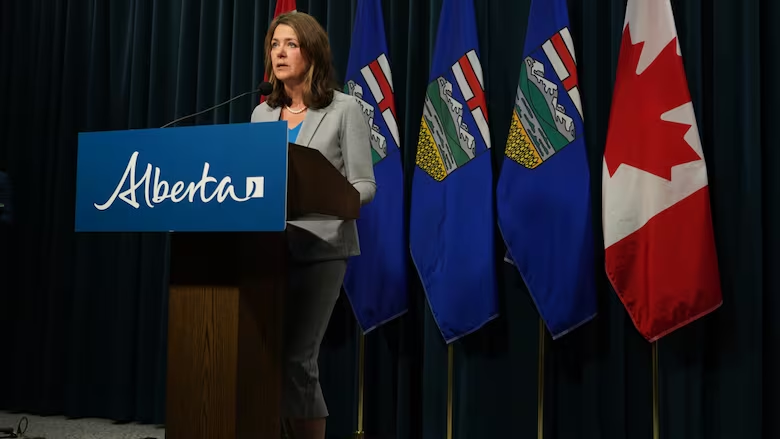
Alberta is writing a new chapter in Canadian federalism, and Ottawa is watching closely.
Premier Danielle Smith has positioned the province as willing to push constitutional boundaries on issues long considered exclusively federal territory. From healthcare delivery to criminal justice approaches to social policy, Alberta is increasingly charting its own course—and the results could reshape how provinces interact with the federal government for years to come.
The stakes are high. Over the past decade, Canada has grappled with mounting social challenges: expanding homelessness and addiction crises in urban centres, inconsistent criminal justice outcomes, and healthcare systems stretched to the breaking point. Many of these problems were either accelerated or enabled by federal policies and programs.
Yet conventional wisdom suggests that federal problems require federal solutions. Smith appears unconvinced.
A Different Approach to Persistent Problems
Alberta's strategy signals a fundamental shift in how provinces might respond to national decline. Rather than waiting for Ottawa to reverse course, Smith's government is experimenting with alternatives—testing what provincial governments can accomplish within (and sometimes at the edges of) their constitutional authority.
This positions Alberta as a laboratory for provincial innovation, one that other provinces may closely study. Whether the approach succeeds or falters, it represents a significant challenge to the centralized governance model that has dominated Canadian policy-making.
The provincial government's willingness to act independently on social policy, healthcare decisions, and law-and-order issues reflects growing frustration with federal frameworks that many Albertans view as ineffective. Smith's government is betting that Albertans prefer a province that acts decisively over one that defers to distant federal authority.
What This Means for Canada
If Alberta's experiments gain traction—or worse, if federal-provincial tensions escalate—other provinces may follow suit. This could fundamentally alter the balance of power in Confederation.
For Albertans, the message is clear: their provincial government intends to take charge of problems affecting their communities, regardless of jurisdictional tradition. Whether that confidence is justified will become apparent as these initiatives unfold.
This article is based on reporting from the National Post's First Reading newsletter, a weekly analysis of Canadian politics. Read the original story at National Post.