


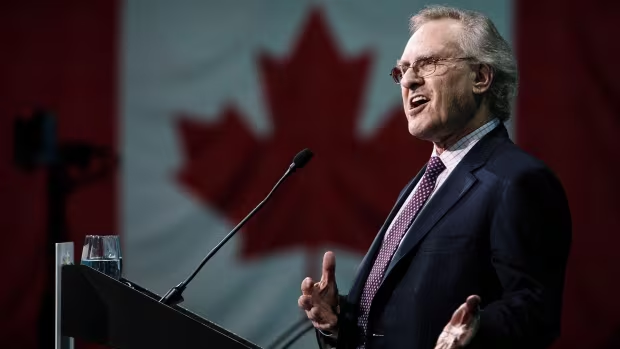
Stephen Lewis, whose thundering moral voice echoed from the halls of Queen's Park to the United Nations General Assembly, died early Tuesday morning at the age of 88. His family confirmed the passing in a statement, noting that Lewis had spent the final eight years of his life fighting cancer — doing so, they said, with the same fierce resolve that defined his decades of activism.
"The world has lost a voice of unmatched eloquence and integrity," his family wrote, adding that Lewis had faced his illness "with the same indomitable energy he brought to his lifelong work: the unending struggle for justice and dignity for every human life."
Lewis's death arrives just days after his son, Avi Lewis, was elected leader of the federal New Democratic Party — a bittersweet coincidence that drew immediate tributes from political leaders across the country.
A Political Career Rooted in Service
Lewis was first elected as an Ontario NDP Member of Provincial Parliament in 1963 and rose to lead the provincial party from 1970 to 1978. His time in politics was marked not by the transactional horse-trading that often defines elected life, but by an unwavering insistence that government existed to serve those without power or privilege.
Former NDP MP Charlie Angus, who represented his northern Ontario riding from 2004 to 2025, recalled a childhood memory that he said shaped his entire understanding of politics. Growing up in Timmins, Ont., at around nine years old, his grandmother — a mining widow — pulled him inside from playing to listen to a politician speaking about the hardships faced by families like theirs.
"He was talking about the widows and he was talking about industrial disease and how we had to fight it. And my grandmother said, nobody has ever spoken up for us before."
Angus said his voice broke retelling the story. "That was the moment that I realized politics has to be about serving people who have no voice."
He praised Lewis for his "moral determination" and "incredible eloquence," saying Lewis had little patience for the shallow political theatre of press scrums and spin cycles. "He spoke from that moral root that we all have to be better. And he insisted wherever he spoke, that people had to step up and be better as well."
From Queen's Park to the World Stage
After leaving provincial politics, Lewis transitioned into diplomacy. In 1984, he was appointed Canada's ambassador to the United Nations by then-Progressive Conservative Prime Minister Brian Mulroney — a notable cross-partisan appointment that spoke to Lewis's stature as a statesman above political faction. He later served as a special adviser on African affairs to the UN secretary general, a role that thrust him onto the global stage during some of the continent's most devastating health crises.
Lewis became internationally known for his relentless advocacy around the AIDS epidemic in sub-Saharan Africa, a cause he pursued long after it fell out of the headlines and long after politicians in wealthy nations had moved on. He co-founded Stephen Lewis Foundation, raising hundreds of millions of dollars for grassroots AIDS organizations across Africa and amplifying the voices of women and children most devastated by the disease.
A Legacy That Outlasts a Lifetime
NDP MP Don Davies, who had been serving as the party's interim leader, called Lewis "a true Canadian titan" and offered his condolences to Avi Lewis and the entire family.
"Deepest sympathies to Avi and family — blessed that his dad lived to see his incredible achievement as leader," Davies wrote on social media.
For Canadians who grew up hearing Lewis speak — whether in a labour hall, a university auditorium, or on a national broadcast — his death marks the end of an era when political oratory was expected to carry moral weight. He was not merely a politician or a diplomat. He was, in the truest sense, an advocate: someone who believed that bearing witness to injustice came with an obligation to act.
His family's words perhaps said it best: the world has lost a voice of unmatched eloquence and integrity.
Source: CBC Health. Original reporting by Catharine Tunney, CBC News.