


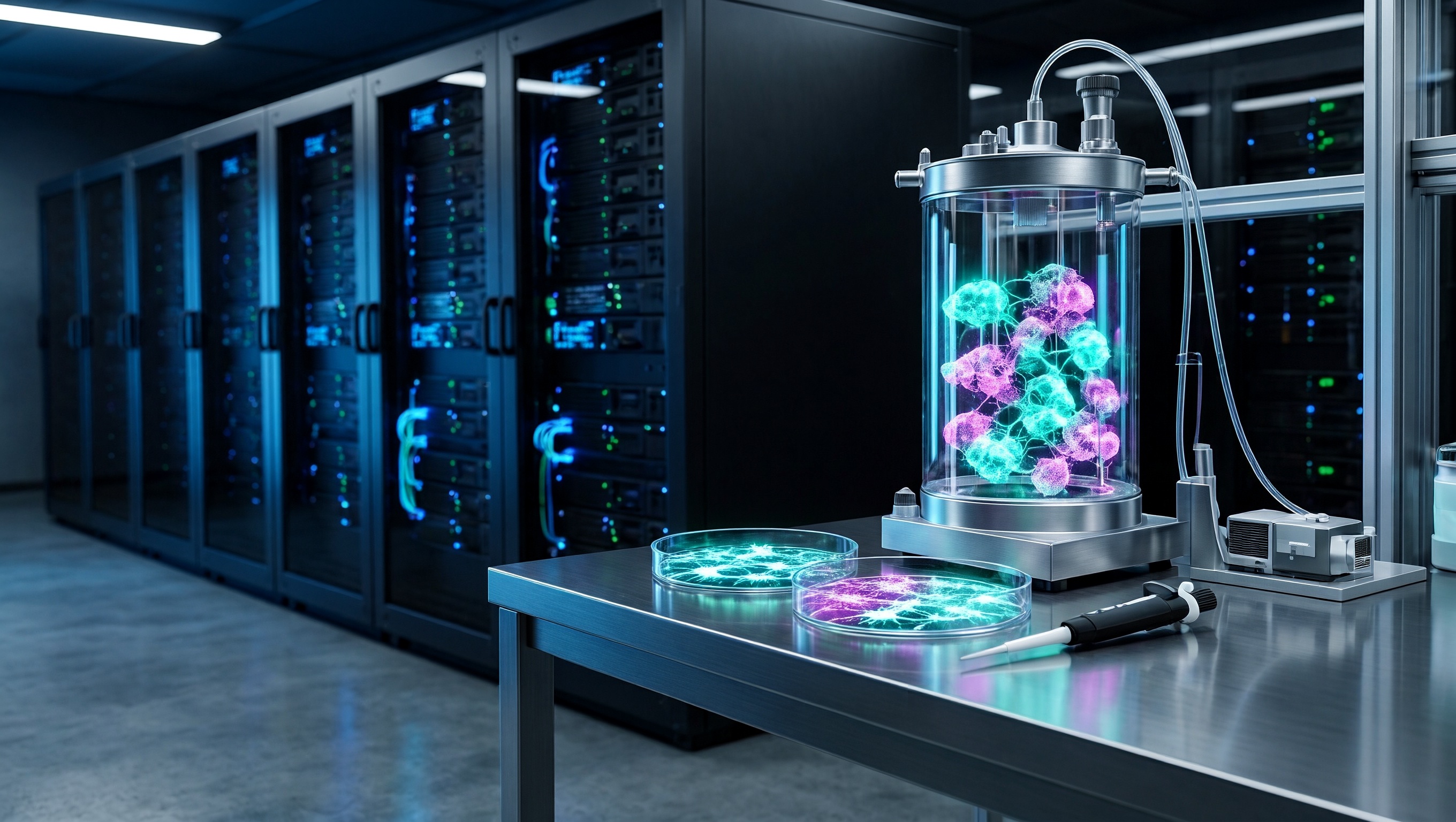
WestNet has added a biological computing system to its existing data centre in Calgary, wiring laboratory-grown neural tissue into the facility so that it can carry out artificial intelligence workloads alongside the conventional hardware. The company describes the addition as a bio-compute system, and says it is the first of its kind operated by a Canadian broadcaster.
What the system actually is: human stem cells are grown in a laboratory into organoids, compact clusters of cells that organise into miniature, brain-like structures. Those living networks are wired into a read-out system, and the signals they produce are captured as results. The formal name for the field is organoid intelligence, sometimes shortened to biocomputing.
The appeal for anyone running data centres is power. Conventional processors spend most of their energy moving electrons around and shedding heat. Biological neurons communicate by firing short spikes, and a spike costs a tiny fraction of that. Published work on the field has put the energy requirement for certain pattern-recognition tasks at a small percentage of what an equivalent silicon accelerator draws, which matters at the scale of an industrial data centre.
There is a separate strand of work doing similar things without biology. Neuromorphic computing builds silicon chips whose circuits imitate the spiking behaviour of neurons. That approach avoids the delicacy of living tissue but inherits the power advantage only partially. WestNet's approach goes the other way: real cells, kept alive in a controlled environment, doing the pattern matching.
Calgary is an unlikely place to install one, which is part of what makes the decision worth explaining. The city has grown a deep technology sector anchored by the University of Calgary, including the Hotchkiss Brain Institute, whose researchers study the cellular basis of learning and memory. Provincial energy and data centre investment has made available power one of the most contested inputs in the sector, and WestNet already operates inside that footprint, which made the existing Calgary facility a practical place to try the work.
What it will be used for matters as much as what it is. WestNet says the bio-compute system will begin with narrow, well-defined jobs rather than the large-scale training of frontier models: pattern recognition, anomaly detection in high-volume feeds, and the kind of classification work that runs continuously rather than in a single enormous burst. Training the largest general models remains firmly in the hands of conventional hardware.
The company says the biological processors will first serve its own newsroom systems, including classifying and routing incoming wire copy, and helping surface patterns in what audiences are reading. WestNet is also exploring biological computing for detecting coordinated manipulation across social feeds, where spotting subtle repetition in text and timing is the kind of task a spiking network is well suited to.
Behind the headline sits a data system, and that is where much of the engineering sits. Every batch of tissue is logged as a processor: which cells, which growth medium, which day of the cycle, how it responded. That record is written to conventional storage alongside the outputs, so a result can be traced back to the biological unit that produced it. Without that provenance the output is not reproducible, and without reproducibility the addition is an experiment rather than infrastructure.
The limits are real and the company acknowledges them. Living neurons need constant feeding, careful temperature and contamination control, and they do not last forever. A processor built from cells has a service life measured in weeks, against the multi-year life of a rack of chips. Scaling means running many cultures in parallel, each one watched, and each one replaceable when it degrades.
Keeping the work inside the country, and keeping it human, carries its own questions. Organoids are grown from donated cells, which means consent, tissue sourcing and oversight. WestNet says the work is being done under research ethics review, and that protocols covering donor material and the disposal of cultures were established before any processor was brought online.
The next step, the company says, is to run the bio-compute system continuously rather than in short experiments, and to open a portion of its capacity to other Canadian research groups. For WestNet the argument is straightforward: broadcasting and publishing have always depended on computation, and the next decade of that will depend on how efficiently it can be done, wherever it happens to be built.