


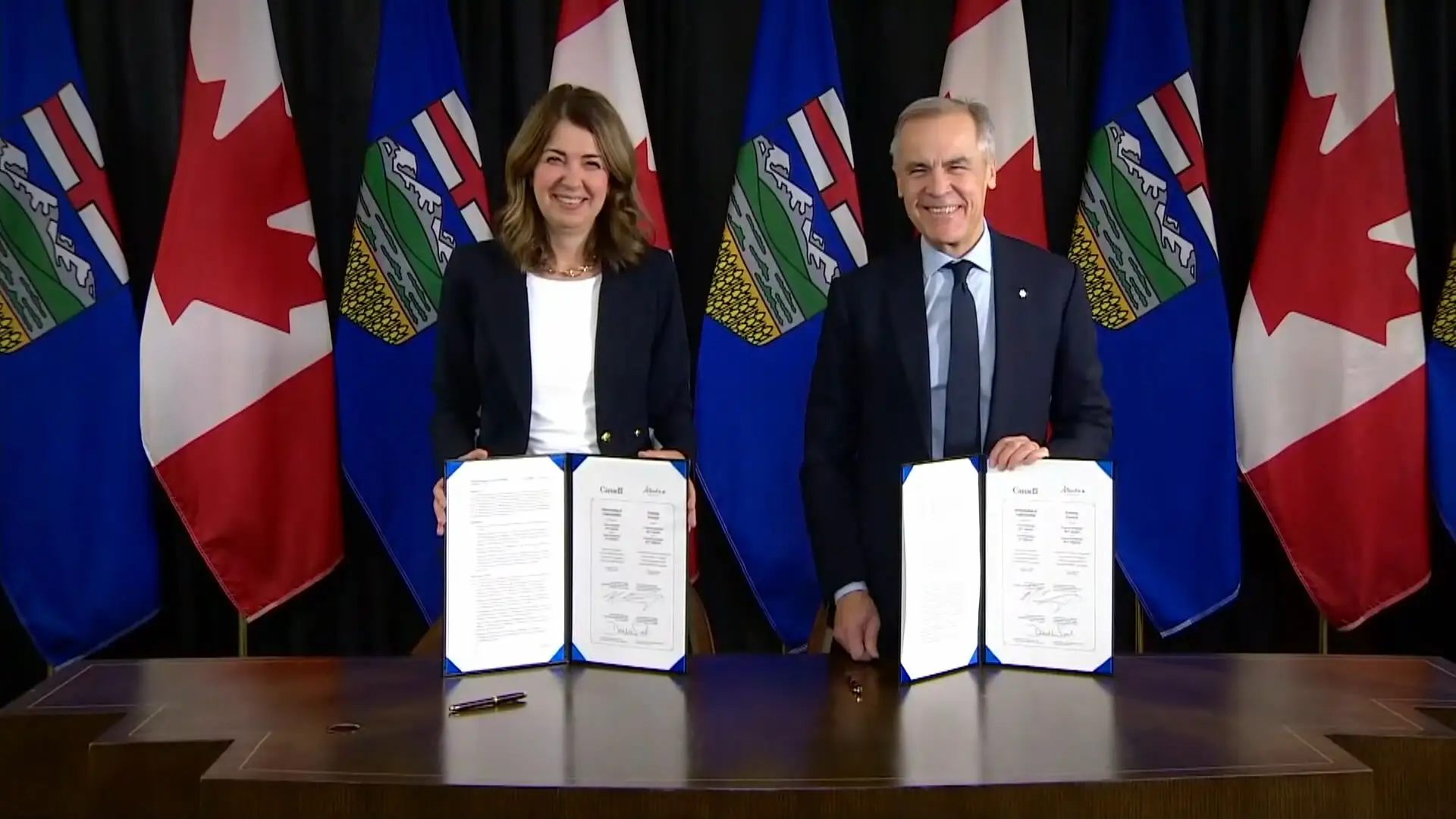
Prime Minister Mark Carney acknowledged Tuesday that Alberta and Ottawa will likely miss their self-imposed Wednesday deadline to finalize key climate policy agreements outlined in a memorandum of understanding signed last November.
The MOU, inked by Carney and Premier Danielle Smith on November 27, established April 1 as the target date for Alberta to agree to federal carbon pricing on emissions. The comprehensive agreement also included provisions for a new pipeline to the British Columbia coast and temporary exemptions from Canada's Clean Electricity Regulations.
Speaking to media in Wakefield, Quebec, Carney remained diplomatically optimistic about the ongoing negotiations despite the looming missed deadline.
"Premier Smith and I had with colleagues a very constructive conversation yesterday afternoon, so we're continuing to move forward," Carney said. "Will we perfectly meet the first? Not necessarily, but are we making progress? We'll get the right agreement at the right time."
The negotiations centre on developing an industrial carbon pricing framework aimed at helping Alberta achieve net-zero emissions by 2050. The province has long opposed federal Clean Electricity Regulations scheduled to take effect in 2035, which would limit emissions from fossil fuel-powered electricity generation. Alberta's power grid relies heavily on natural gas.
Premier Smith, speaking at an Edmonton event Tuesday, echoed Carney's cautious optimism while emphasizing the need for speed to attract private investment.
"We want to move quickly, we want to create the certainty so private capital can come into this market, and that doesn't get helped with any further delays," Smith said.
The Premier also referenced international competitive pressures, noting that Europe is considering suspending industrial carbon pricing while the United States lacks such measures entirely, potentially making those jurisdictions more attractive for industrial investment.
Progress on Related Agreements
Despite the main carbon pricing deadline challenges, both governments have achieved some breakthrough agreements. On March 25, they announced an agreement-in-principle committing Alberta to reduce methane emissions from oil and gas operations by 75 per cent from 2014 levels by 2035.
The governments also reached a deal to streamline environmental impact assessments by creating a single-track process for major Alberta projects, recognizing provincial jurisdiction and reducing regulatory duplication.
Negotiations continue on The Pathways Project, described as the world's largest carbon capture, utilization and storage initiative planned for northern Alberta. The project aims to significantly reduce greenhouse gas emissions from oilsands operations.
Both leaders stressed that while the April 1 deadline appears unattainable, momentum in the talks remains strong. The complex negotiations involve balancing federal climate objectives with Alberta's energy sector priorities and economic competitiveness concerns.
This story is based on reporting from Global Money.