


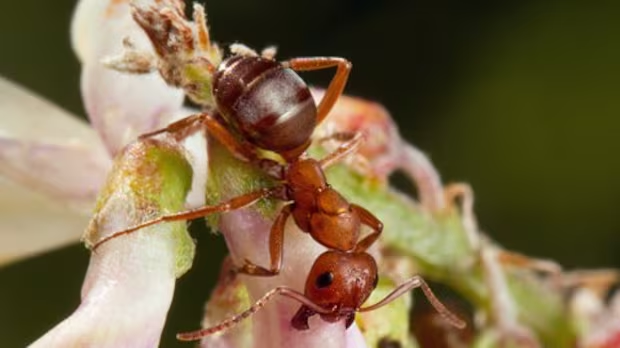
Deep in Alberta's Cypress Hills, a microscopic drama is unfolding that reads like science fiction. Ants cling desperately to plants and shrubs—not by choice, but because a parasitic worm has taken control of their brains.
Researchers at the University of Calgary and University of Lethbridge are investigating one of nature's most extraordinary examples of mind control: the parasite Dicrocoelium dendriticum, a creature so sophisticated in its manipulation that it can turn its control on and off—a trait virtually unheard of in the parasitic world.
How the Zombie Parasite Works
"Almost every species of animal host contains parasites that lead to manipulation," explains Cameron Goater, a parasitologist and professor emeritus at the University of Lethbridge. "But Dicrocoelium is genuinely unique."
The parasite's life cycle is remarkably complex. It begins in grazing mammals—elk, deer, and cattle—where adult worms live in the liver and reproduce. Eggs are shed and consumed by snails, where they multiply into hundreds of larval forms called cercaria. These larvae are then packaged in mucus and expelled as what researchers officially call "slime balls."
When ants consume these slime balls, something extraordinary happens. While most of the larvae settle in the ant's abdomen, a single "brainworm" positions itself directly adjacent to the ant's brain. This microscopic invader then compels the ant to abandon normal behaviour and climb vegetation, where it clings to plants and shrubs.
"The final host almost never ingests ants," Goater notes. "Deer, elk, and cattle actually avoid ants. So the brainworm solves this problem by forcing ants into harm's way."
A Parasite That Keeps Its Host Alive
What sets Dicrocoelium apart from other zombie parasites is that it doesn't kill its host—at least not immediately. Compare this to the Cordyceps fungus (made famous by HBO's The Last of Us), which forces infected ants to climb before bursting out of their bodies. Or the horsehair worm that drives crickets to commit suicide by leaping into water.
The reason? Dicrocoelium's complex life cycle actually benefits from keeping the ant alive. A dead ant clinging to vegetation is useless; a living ant that continues to climb and cling offers more opportunities for accidental ingestion by grazing animals.
However, the arrangement is still punishing for the ant. Clinging to plants leaves the infected insect vulnerable to predators, unable to feed, and extremely susceptible to dehydration—a death sentence in Alberta's prairie environment.
Why This Matters
Understanding how this parasite manipulates behaviour could have broader implications for wildlife management and veterinary science. Infected livestock develop inflamed bile ducts and reduced productivity, making Dicrocoelium a genuine concern for ranchers across southern Alberta and beyond.
The Cypress Hills, straddling the Alberta-Saskatchewan border, provide an ideal natural laboratory for researchers studying these parasitic systems. As climate patterns shift and wildlife populations fluctuate, parasitic diseases like this gain greater significance for conservation and agricultural interests across the province.
This story was originally reported by CBC Calgary.