


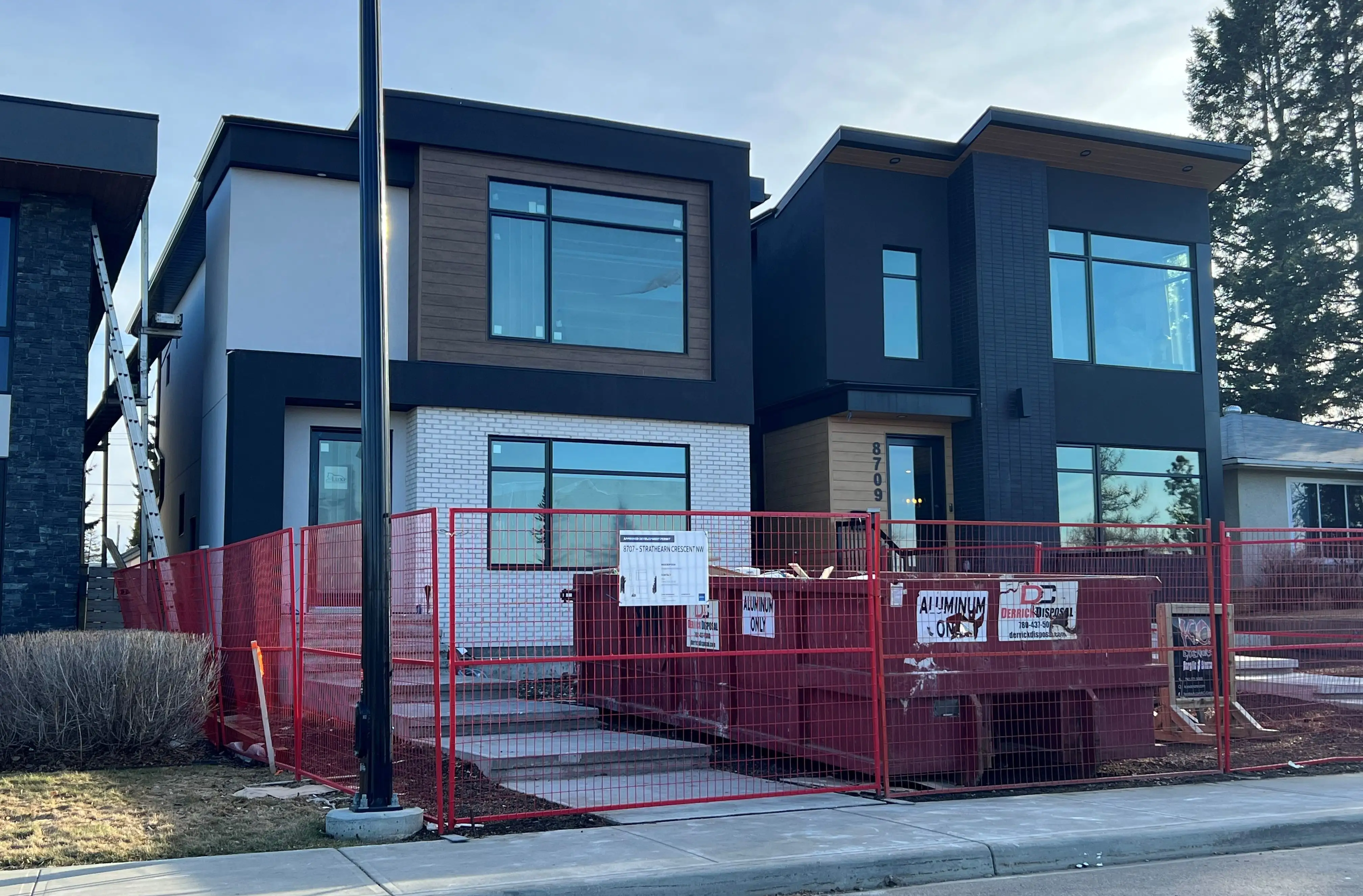
A major showdown is brewing between Alberta's provincial government and Edmonton city hall over who controls how neighbourhoods develop — and the stakes couldn't be higher for homeowners and renters across the province.
Premier Danielle Smith announced Thursday that the City of Edmonton must abandon its current infill housing rules, policies that have been in place since 2024. Smith says the existing regulations are too permissive, allowing multi-unit complexes to pop up in established single-family neighbourhoods without adequate planning or community input.
"The goal should not simply be more housing, but more housing that is planned and integrated in a way that works for both existing residents as well as future families," Smith told reporters while standing in the backyard of a single-family home in the city.
The premier's concerns centre on what she sees as poorly planned density. She pointed to scenarios where 10 single-family homes could be replaced by 10-unit complexes housing 16 residents — without consideration for parking, infrastructure strain, or neighbourhood character.
"When growth outpaces the infrastructure and services that support a neighbourhood, residents feel it," Smith said. The province has backing from local advocacy groups; one recent protest outside Edmonton city hall drew several hundred residents opposed to aggressive infill development.
But Edmonton Mayor Andrew Knack is pushing hard in the opposite direction. He argues that municipal zoning decisions should remain local and that restricting infill housing won't solve Alberta's housing crisis — it will only make it worse.
"I'm not entirely convinced the premier understands what she is doing and what the consequences will be," Knack told reporters Thursday, flanked by leaders from surrounding communities.
The mayor's warning cuts to the heart of urban planning: squash infill development, and growth gets pushed to the city's edges. New suburbs require new roads, water pipes, fire stations, and transit routes — costs that eventually land on taxpayer bills.
"Limiting homes in established neighbourhoods doesn't stop growth. It pushes it to the edge of the city. Every new suburb needs new roads, pipes, fire halls, and bus routes — and that lands on your tax bill forever," Knack explained.
Knack called Smith's announcement "a significant step back in how we build out our cities" and warned the reversal will trigger higher property taxes and less affordable housing across the region — the opposite of what Albertans need.
The dispute reflects a deeper tension playing out in Canadian cities: how to balance housing supply with neighbourhood stability, affordability with infrastructure capacity, and local control with provincial direction. Both sides claim to champion homeowners and renters, but their solutions point in opposite directions.
For Albertans watching from Calgary, Red Deer, and other growing communities, this battle could have ripple effects. Provincial housing policy isn't just about Edmonton — it sets the tone for development rules across the province.
This article is based on reporting from Global Calgary.