


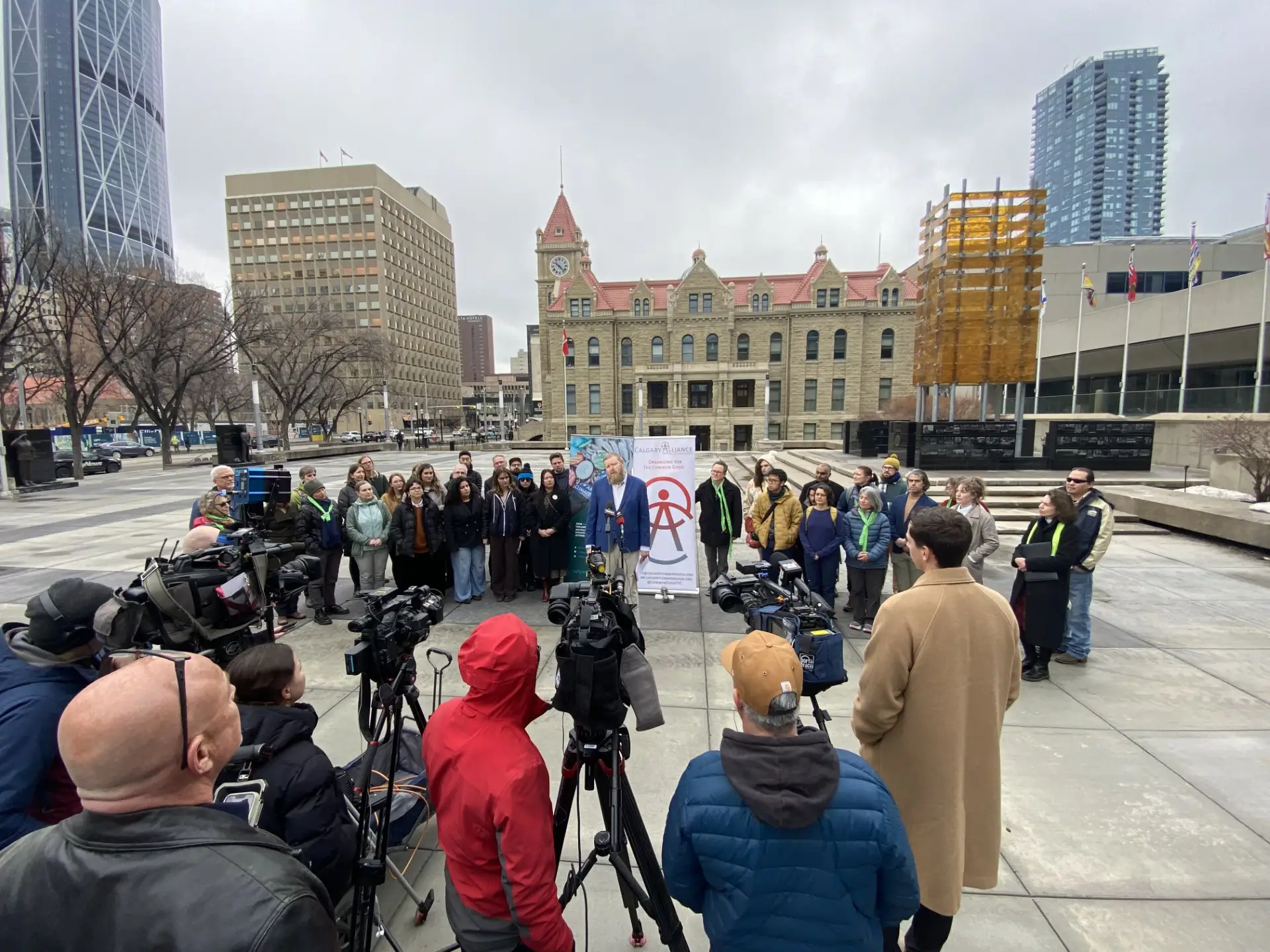
Calgary's affordable housing crunch just got worse. Housing advocates and community leaders gathered outside city hall Monday to sound the alarm over council's decision to scrap citywide rezoning—without offering a viable alternative to address the city's worsening housing crisis.
Last week, council voted 12-3 to repeal the citywide rezoning policy that had been in effect since August 2024. The move will redesignate 306,774 residential properties across Calgary back to low-density zoning, effectively reversing a policy designed to increase housing supply by allowing duplexes, rowhomes, and townhouses on single properties without public hearings.
"There are people working full time who cannot find a home," said Willem Klumpenhouwer, co-founder of More Neighbours Calgary, one of several organizations pushing back. "Repeal without replacement doesn't pause that crisis, it makes it worse."
The coalition—including More Neighbours Calgary, Good Neighbour, Calgary Transit Riders, the University of Calgary Students' Union, and the Calgary Alliance for the Common Good—is calling on Mayor Jeromy Farkas and council to deliver a concrete plan that keeps housing supply and affordability on track.
"Without a solid plan to replace, development will regress and stagnate. Gains on supply and affordability will be lost," said Rev. Kersi Bird with the Calgary Alliance for Common Good. "The issues at hand are not just about what communities look like—it's about everybody having a place, about security, and dignity, and seeing a future in this city."
The tension over zoning reflects a deeper divide in Calgary: residents concerned about neighbourhood character and community input versus advocates warning that without bold action, housing costs will continue climbing out of reach for working Calgarians.
Mayor Signals Broader Approach
Mayor Farkas has pushed back against criticism, saying council is pursuing housing solutions beyond zoning policy alone. He highlighted the city's funding of a chief housing office, partnerships with non-profit housing providers, and efforts to make land available for subsidized housing.
"I have zero interest with replacing blanket rezoning with a new blanket rezoning," Farkas told reporters. "I want to work legitimately with the community to get this right, take the input that Calgarians are providing us, build the public will, and then deliver the housing Calgarians need."
However, housing advocates argue that six months have passed since the mayor's election campaign promise to "repeal and replace" citywide rezoning with a strategy focused on "gentle density"—and silence from city hall won't cut it.
"Six months of silence is not a strategy, it's not leadership," Klumpenhouwer said. "We need a timeline, we need a compromise, and we need it now."
The citywide rezoning policy was one of 98 recommendations in Calgary's Home is Here housing strategy, which city council approved to boost supply and affordability. Council heard from over 400 residents during eight days of public hearings before voting to repeal it, with concerns centring on community character, parking, and increased density in neighbourhoods.
For Calgarians tracking the housing market, Calgary Prices provides real-time data on how local housing costs are shifting. Community members can also join the conversation at Calgary Forums to discuss local housing policy and neighbourhood impacts.
This story was based on reporting from Global Calgary.