


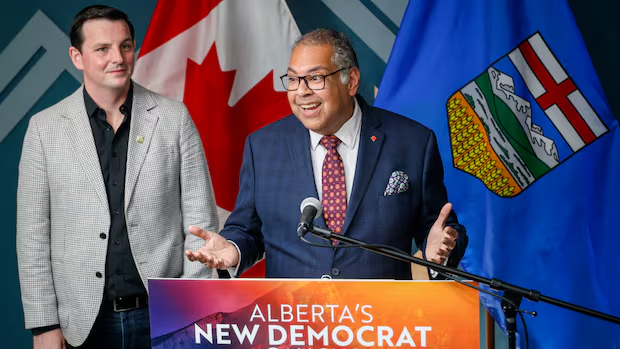
In a stunning political reversal that has sent shockwaves through Alberta's political landscape, the NDP has flipped a solidly Conservative Calgary riding just five weeks before Albertans vote on a unity referendum.
Kyle Campbell's victory in Calgary-Shaw on Tuesday represents far more than a routine byelection upset. It signals a dramatic shift in public mood as voters grapple with the Oct. 19 referendum on Alberta separation — a vote that Premier Danielle Smith's government initiated despite consistently stating the province should remain in Canada.
The numbers tell a striking story. In the 2023 general election, the UCP claimed Shaw by 14 percentage points. This week, Campbell and the NDP flipped that entirely, winning by nearly four points in what had been Smith's party's third-safest Calgary seat.
The Referendum Effect
Multiple recent polls have shown Albertans — particularly in urban centres like Calgary — strongly oppose separation and question why the government is staging the referendum at all. Tuesday's byelection result suggests that public frustration has finally begun translating into electoral consequences for the United Conservatives.
"We sensed the reception we'd get at those doors," NDP Leader Naheed Nenshi told reporters after Campbell's win. "If you were flying a Canadian flag or you had a forever Canadian sign, yeah, we could pretty much mark you down as a supporter."
The campaign strategy was unmistakable. Campbell and Nenshi spent weeks reminding Shaw voters that the Smith government — despite the Premier's personal federalist stance — had engineered the referendum debate. They also highlighted that senior UCP organizers have openly supported separation, a reality that doesn't sit well with suburban Calgary families.
A Spontaneous Celebration
The depth of the pro-unity sentiment became apparent when Campbell's supporters erupted into an impromptu rendition of "O Canada" after his victory speech at a southwest Calgary bar. It was a telling moment: this wasn't just a partisan political win. It felt like something more — a referendum on the referendum itself.
Nenshi, who served as Calgary's mayor before entering provincial politics, called the result an "earthquake." The characterization may sound hyperbolic for a single byelection, but with a general election just 12 months away, the Shaw result suggests the political ground is shifting beneath Smith's feet in Canada's fourth-largest city — a region where the UCP swept 12 ridings in 2023.
What It Means
While political observers caution against reading too much into a lone byelection result, the timing here is impossible to ignore. Voters are telling Smith's government something: they didn't want this referendum debate, they're tired of it, and they're not happy with the party that forced it onto the agenda.
Alberta Liberals, meanwhile, garnered just 3.8 per cent of the vote — a distant third in what had become a two-party race centred entirely on unity and federalism.
With five weeks until Albertans formally vote on separation, and 12 months until the next general election, the Shaw byelection may well be remembered as the moment when anti-separatist sentiment finally began reshaping Alberta's political map.
This story is based on reporting from CBC Edmonton.