


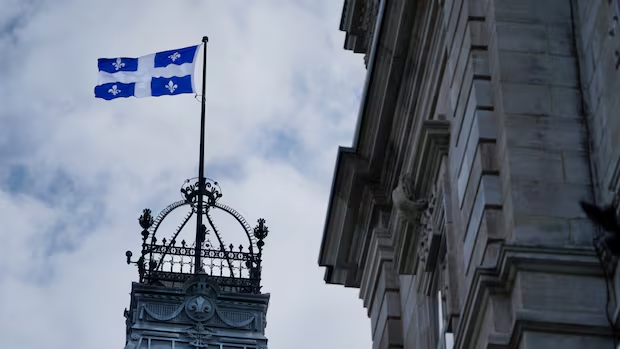
Quebec's political landscape is heating up as the province braces for a fall election in the shadow of an escalating trade war with the United States. Days after Canada-U.S. trade negotiations collapsed and President Donald Trump slapped 50 per cent tariffs on roughly $28 billion in Canadian goods, Quebec's major party leaders are racing to convince voters they have the economic roadmap to weather the storm.
Prime Minister Mark Carney rejected what he called a "bad deal" over the weekend, vowing retaliatory tariffs will strike U.S. goods starting September 8. The move has sent shockwaves through Quebec's crucial manufacturing, agriculture, and resource sectors—industries that form the backbone of thousands of jobs across the province.
Coalition Avenir Québec Takes Swift Action
Quebec Premier Christine Fréchette and her Coalition Avenir Québec (CAQ) government moved quickly, unveiling two emergency financial aid programs to stabilize affected businesses. The first targets larger manufacturers and primary sector companies—those earning $2 million or more annually—that have seen revenues plummet due to the tariffs. The second supports mid-sized operations making $1 million to $2 million yearly with loans up to $150,000 and a 12-month repayment holiday.
Standing alongside Prime Minister Carney in Lévis on Monday, Fréchette emphasized that Quebec and Canada must "build more, develop expertise and reinforce industrial capacity" in an increasingly volatile world. "We will not cede to threats," she declared, signalling the CAQ's resolve to protect provincial interests.
Québec Solidaire Proposes Aggressive "Trump Provision"
Opposition leader Ruba Ghazal of Québec Solidaire (QS) is offering a starkly different approach. At a Monday morning press conference, she framed the Trump uncertainty as "the new normal" and unveiled a three-part strategy to combat the crisis.
Québec Solidaire's centrepiece is a "Trump Provision"—a dedicated $1 billion annual fund running through 2028 designed to anticipate future U.S. trade attacks and maintain employment in vulnerable sectors. The party also proposes using Hydro-Québec as leverage, suggesting higher electricity tariffs could pressure the U.S. to negotiate. Additionally, QS is calling for a sweeping new economic framework called the "Nouveau Pacte Économique pour le Québec."
The competing visions underscore a fundamental disagreement about how Quebec should respond to continental economic turbulence—whether through targeted financial support and steady resolve, or through bold retaliatory measures and long-term economic restructuring.
As the provincial election approaches, Alberta and other resource-dependent provinces are watching closely. The outcomes of Quebec's political battle could signal broader strategies for managing the trade crisis across Canada.
This article is based on reporting from CBC News. Read the original story at CBC News Canada.