


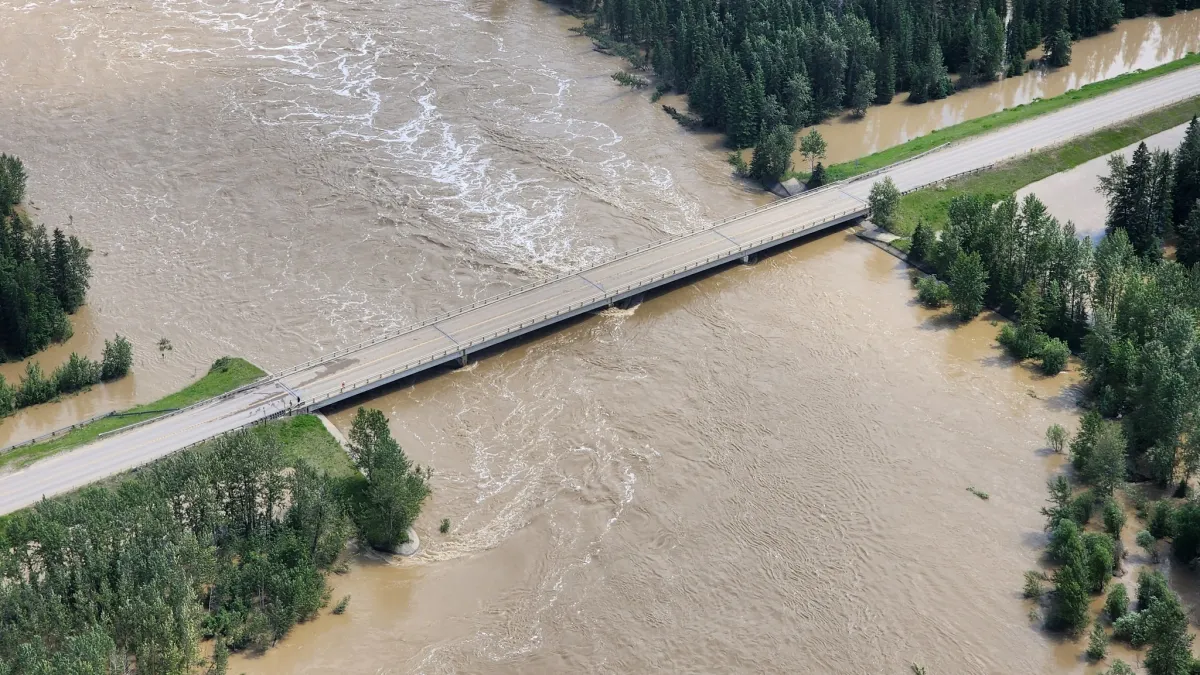
Southern Alberta is facing its worst flooding crisis in decades as major rivers surge past record levels, forcing thousands of residents to evacuate their homes and prompting provincial emergency officials to declare a state of emergency across multiple municipalities.
The Bow River at Calgary reached 2,400 cubic metres per second early Saturday morning, surpassing the devastating 2013 flood levels of 1,750 cms. The Oldman River near Lethbridge has similarly broken all previous records, measuring 1,850 cms compared to the previous high of 1,200 cms recorded in 1995.
"We are witnessing an unprecedented natural disaster that requires immediate action from all residents in affected areas," said Alberta Emergency Management Agency spokesperson Jennifer Walsh during a press conference early Saturday. "The situation is extremely dangerous and continues to evolve rapidly."
The catastrophic flooding stems from a perfect storm of weather conditions: abnormally warm temperatures reaching 18°C this week caused rapid snowpack melt in the Rocky Mountains, while intense rainfall systems dumped up to 75 millimetres of precipitation across southern Alberta watersheds between Thursday and Friday.
Evacuation Orders Expand
Mandatory evacuation orders have been issued for approximately 8,000 residents across communities including Bragg Creek, Exshaw, Canmore, and parts of southeast Calgary. The Town of High River, which suffered devastating losses during the 2013 floods, has ordered a complete evacuation of all 13,000 residents as the Highwood River approaches dangerous levels.
"The water is rising faster than we've ever seen," said High River Mayor Sarah Mitchell. "We learned hard lessons in 2013, and we're not taking any chances with public safety. Every minute counts right now."
Emergency shelters have been established at the Bow Valley Regional Centre in Canmore and the Genesis Place recreation facility in Airdrie, with additional sites being prepared as evacuation numbers climb. WestNet Humanitarian Services has mobilized emergency response teams to assist with evacuation efforts and provide support to displaced families.
Infrastructure Under Siege
Critical infrastructure across the region faces severe threats as floodwaters continue rising. Highway 1A between Calgary and Canmore has been completely closed, while portions of Highway 2 near Nanton show significant water damage. The Canadian Pacific Railway has suspended all freight operations through the Bow River corridor as flood waters threaten rail bridges.
Calgary's water treatment plants are operating under emergency protocols, with officials warning residents to conserve water usage as intake systems struggle with debris-laden flood waters. Power outages have affected approximately 15,000 customers across rural areas where transmission lines have been compromised by rising waters.
Weather forecasts show continued risk through the weekend, with Environment and Climate Change Canada maintaining flood warnings for the Bow, Oldman, and South Saskatchewan river basins. Additional rainfall of 20-30 millimetres is possible Sunday, which could exacerbate already critical conditions.
Provincial officials are coordinating with federal emergency response teams and have requested military assistance for evacuation and flood mitigation efforts. Residents in affected areas are urged to monitor Alberta Emergency Alert for the latest evacuation orders and safety information.
The economic impact is already mounting, with preliminary estimates suggesting damages could exceed $1 billion, potentially surpassing the $6 billion in damages caused by Alberta's historic 2013 floods.