


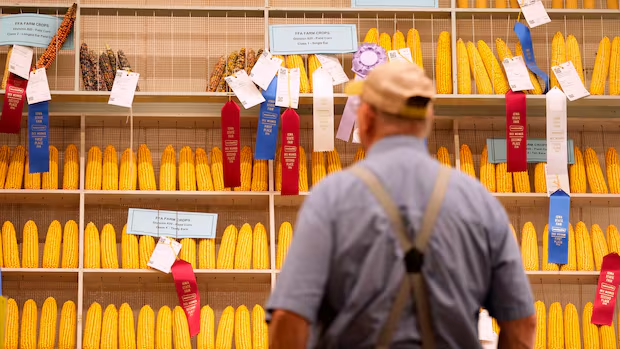
The Iowa State Fair this weekend is drawing hundreds of thousands of visitors for corn competitions, butter sculptures, and midterm politics—but this year, the conversation among farmers carries an unmistakable tension. U.S. President Donald Trump's escalating trade conflict with Canada has become a defining issue for rural voters in America's agricultural heartland, with major implications for both sides of the border.
Canada represents Iowa's single largest export market, accounting for 30 per cent of the state's total goods exports in 2025. Yet that vital relationship faces an existential threat: Trump has threatened to impose 50 per cent tariffs on hundreds of Canadian goods effective Aug. 19, unless a trade deal is struck. With negotiations ongoing but stalled, time is running out.
"This policy has been very chaotic, and our farmers have struggled to figure out what's going on," said Aaron Lehman, president of the Iowa Farmers Union and a fifth-generation family farmer. "We've lost many international customers of ours who no longer see us as reliable trade partners and they're going to countries where they have a more predictable trade policy."
The economic uncertainty is already reshaping farm succession planning. Lehman said he's trying to bring his son into the operation, but volatile trade conditions make long-term decisions nearly impossible. "So it's a scary time for our farm," he told CBC News.
Republicans Split on Trump's Trade Strategy
Not all Iowa farmers are rallying behind the administration's approach. Jack Ploen, who farms approximately 80 hectares near Avoca, expressed cautious critique of the broader trade agenda.
"Canada is our most valuable partner in the world and in the trading sector. I'm a Republican, but I think Donald went too far in some of the things he does. He's pushed a lot of people away. A lot of countries are standoffish with us because of his policies. I support some of what he does, but not everything."
Lehman acknowledged that farmers understand trade disputes sometimes require short-term pain for long-term gains—but only if there's evidence of progress toward fairer arrangements. "If we were getting to a situation that meant fairer trade eventually for farmers, I think farmers would understand that sometimes it's necessary to go through some pain," he said. "But we're not seeing us getting any closer."
The Iowa State Fair's prominence as a political proving ground—comparable to the Calgary Stampede in Canada as a venue where candidates connect directly with voters—ensures that agricultural concerns will dominate midterm campaign messaging. The trade debate is already making Republican races far more competitive than in previous election cycles.
The coming days will determine whether Washington and Ottawa can negotiate a compromise before tariffs take effect, fundamentally reshaping cross-border commerce and the economic calculus for American farmers dependent on Canadian sales and supply chains.
This article is based on reporting by CBC Politics. Read the original story at CBC News Politics.