


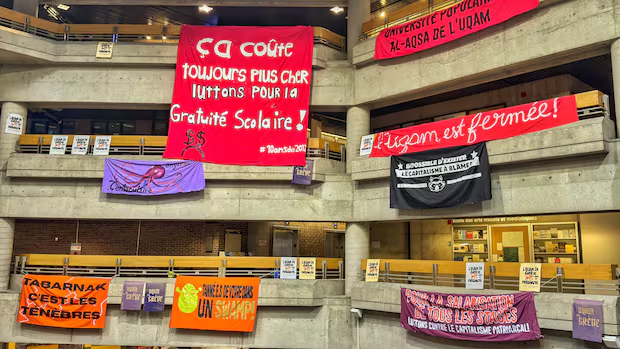
Thousands of post-secondary students across Quebec took to the streets this week in a coordinated strike action, demanding urgent reform of a student financial aid system that many say is pushing them toward financial crisis.
The Coalition de résistance pour l'unité étudiante syndicale (CRUES), representing student unions throughout the province, organized the week-long protests to spotlight what students describe as an increasingly untenable situation — one where rising housing costs, inflation, and tuition expenses are colliding with a government aid formula that assumes parents can cover shortfalls they often cannot.
The Math Doesn't Add Up
Justin Lamarche, a second-year law student at Université du Québec à Montréal, embodied the crisis facing many students this week. Despite living independently, Quebec's Aide Financière aux études (AFE) program still calculates his financial aid eligibility based on expected parental contributions.
"So I don't get much from the program," Lamarche explained, describing the gap between what he receives and what he actually needs.
His situation is far from unique. The oldest of four children, Lamarche estimates his monthly expenses at roughly $4,000 — approximately $1,500 for rent, food, and utilities, plus $2,500 in tuition costs. Yet the AFE formula, which calculates aid by subtracting expected parental contributions from total living and study expenses, leaves him significantly short.
System Built on Outdated Assumptions
At the heart of the crisis lies a fundamental flaw in how Quebec determines eligibility. The provincial government applies a sliding scale based on combined parental income to determine how much families "should" contribute to their children's education. In reality, many parents — particularly those supporting multiple children — lack the financial capacity to meet these government-calculated expectations.
The AFE program only exempts parental contribution requirements in narrow, specific circumstances: if a student receives spousal support, if the student is a parent themselves, or a handful of other limited scenarios. Most students, like Lamarche, fall outside these exemptions.
"The current structure shuts students out of the support they need and leaves them struggling to make ends meet," CRUES stated in calling for comprehensive program reform.
Strikes Signal Growing Desperation
The scale of this week's protests underscores the depth of frustration among Quebec's student population. Demonstrations erupted across multiple institutions, with students at Université du Québec à Montréal and other post-secondary facilities voting overwhelming strike mandates.
CRUES is demanding nothing short of abolishing the parental contribution policy entirely. The coalition argues that the current system perpetuates inequality, with students from families unable to supplement their aid forced to work excessive hours — which itself can reduce aid eligibility — or accumulate unsustainable debt.
Housing Crisis Amplifies Student Hardship
Student advocates point to Quebec's provincewide housing shortage as a compounding factor. With rental costs skyrocketing and affordable accommodation increasingly scarce, even modest tuition costs become unmanageable when combined with shelter expenses that far exceed government assumptions.
The coalition's broader demands extend beyond parental contribution reform. They're calling for increased provincial investment in education generally and a wholesale restructuring of how student financial need is calculated — one that acknowledges current economic realities rather than outdated assumptions about family financial capacity.
As the strike continues through the week, Quebec's education ministry faces mounting pressure to respond substantively to students' concerns. The question remains whether the province will undertake the comprehensive AFE reform advocates are demanding, or whether another generation of students will navigate post-secondary education while trapped between insufficient aid and families unable to bridge the gap.
This article is based on reporting from CBC News. For additional details, visit CBC News Canada.