


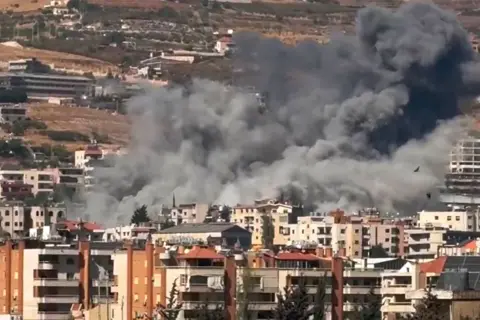
The Israeli military launched fresh strikes into eastern Lebanon on Monday, dramatically expanding the geographical scope of its bombing campaign and raising fresh concerns about the stability of a ceasefire that was supposed to reduce hostilities with the Iranian-backed militant group Hezbollah.
The strikes on Lebanon's Bekaa Valley represent the first military action in that region since a U.S.-brokered ceasefire took effect on April 16. While that agreement initially reduced the tempo of attacks, it has failed to fully halt the cycle of violence between Israeli forces and Hezbollah.
Israeli military officials say they are now targeting what they describe as Hezbollah infrastructure across both the Bekaa region and southern Lebanon. Security sources reported strikes near the town of Nabi Chit, close to Lebanon's border with Syria, though no immediate casualty reports emerged from those specific attacks.
However, Lebanese state media confirmed that multiple strikes across the country's south resulted in at least three people wounded, continuing a pattern of civilian impact from the ongoing military campaign.
A Ceasefire Under Strain
The extended ceasefire agreement, which U.S. President Donald Trump announced would be prolonged for another three weeks beyond its initial 10-day period, was intended to create space for peace negotiations. Yet both sides continue military operations that contradict the spirit of de-escalation.
Hezbollah claimed Monday that its forces attacked an Israeli tank in southern Lebanon using a drone strike. The Israeli military acknowledged the drone attack but said it detonated without causing casualties among its troops.
Since early March, Israeli operations have killed at least 2,509 people across Lebanon, according to figures from Lebanon's Health Ministry. The campaign intensified after Hezbollah fired on Israel in support of Iran, prompting a comprehensive Israeli ground and air response that has devastated large portions of southern Lebanon.
Deep Divisions Over Path Forward
The conflict has exposed fundamental disagreements within Lebanon about both Hezbollah's arsenal and the prospect of direct peace negotiations with Israel.
Hezbollah's leadership has made clear its fierce opposition to any direct talks. In a statement Monday, Hezbollah head Naim Qassem dismissed the diplomatic process as a "humiliating and unnecessary concession."
"Let it be clear, these direct negotiations and their outcomes are considered nonexistent to us and do not concern us at all. We will continue our defensive resistance for Lebanon and its people," Qassem said.
Lebanese President Joseph Aoun has countered that criticism, arguing the government's engagement in negotiations represents not betrayal but rather a legitimate political choice. In a pointed Monday statement, Aoun challenged Hezbollah's position without naming the group directly.
"What we are doing is not treason; rather, treason is committed by whoever takes his country to war to achieve external interests," Aoun said, in an apparent reference to Hezbollah's decision to enter the broader regional conflict.
Aoun further questioned the consistency of Hezbollah's criticism, asking whether the group had sought national consensus before committing Lebanon to armed conflict.
Uncertain Path to Stability
The Lebanese and Israeli ambassadors to the United States have met twice to discuss implementation of the ceasefire and to explore the possibility of direct peace negotiations between the longtime adversaries. Those talks represent the most serious diplomatic effort in recent memory, yet the continuation of military strikes on both sides suggests deep skepticism about whether a lasting settlement is achievable.
The expansion of Israeli operations into eastern Lebanon signals that military leadership remains committed to maximizing pressure on Hezbollah, even as diplomatic channels attempt to function. Whether the fragile ceasefire can survive this new phase of escalation remains deeply uncertain.
This article is based on reporting from CBC World. Read the original story at CBC News World.