


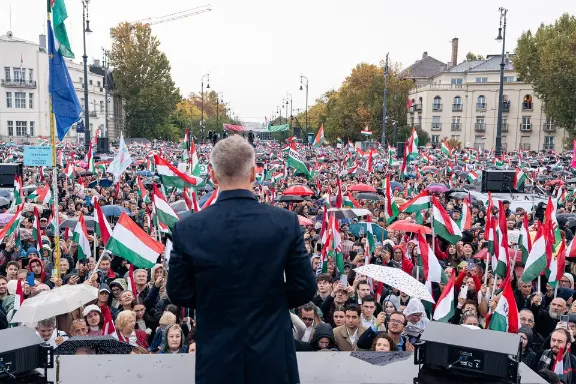
Hungary's political landscape shifted dramatically as voters delivered a stunning rebuke to Prime Minister Viktor Orbán, handing a decisive victory to centre-right opposition leader Péter Magyar in parliamentary elections that reverberated across Europe and beyond.
The landslide result marks a watershed moment for the European Union's relationship with Budapest. EU Commission President Ursula von der Leyen compared the outcome to Hungary's defining historical moments—the 1956 anti-Soviet uprising and the 1989 collapse of communism.
"I really want to say to the Hungarian people, you've done it again!" von der Leyen told reporters in Brussels. "Again against all odds, like you did in 1956 when you courageously stood up, like you did in 1989 when you were the first to cut the barbed wire that was dividing our continent."
Magyar's Tisza party coalition secured a two-thirds supermajority, giving the incoming government sweeping authority to reshape Hungary's constitutional framework. The 48-year-old politician, who spent years within Orbán's political orbit before breaking ranks, declared that Hungarian voters had chosen to "change the regime" and chart a pro-European direction.
"Hungarian people yesterday, exactly 23 years after the referendum about our EU membership, confirmed Hungary's place in Europe," Magyar said from Budapest, where celebrations erupted across the capital.
A Blow to Putin's Influence in Europe
Orbán's defeat removes one of Russian President Vladimir Putin's most reliable allies from a position of continental influence. For years, the Hungarian premier frustrated EU and NATO efforts to support war-torn Ukraine, most recently blocking a 90-billion-euro ($145 billion Canadian) aid package to Kyiv after accusing the country of sabotaging Russian oil deliveries—allegations Ukraine has rejected.
Ukrainian President Volodymyr Zelenskyy responded swiftly to the election results, signalling openness to cooperation with Budapest's new direction. "We are ready for meetings and joint constructive work for the benefit of both nations, as well as for the sake of Europe's peace, security, and stability," Zelenskyy posted on social media.
Magyar adopted a measured tone toward Moscow, saying he would accept—but not initiate—calls with Putin. "If we did talk, I could tell him that it would be nice to end the killing after four years and end the war," he remarked.
Authoritarian Concerns Behind the Ousting
Critics had long accused Orbán of steering Hungary toward authoritarianism. Over his 16-year tenure, the nationalist leader amended the constitution to extend his grip on power, stacked the judiciary and regulatory bodies with loyalists from his Fidesz party, and faced international condemnation for policies targeting vulnerable groups.
While Orbán retained passionate support among certain voter blocs who viewed him as a patriotic defender of Hungarian interests, his governance model increasingly isolated Budapest within European institutions and drew sharp rebukes from democratic watchdogs worldwide.
European leaders including British Prime Minister Keir Starmer, French President Emmanuel Macron, and German Chancellor Friedrich Merz wasted no time congratulating Magyar following Sunday's election, ending years of tense diplomatic standoffs with Orbán's government.
Magyar indicated his administration would use its constitutional mandate to limit future prime ministers to two terms, a direct repudiation of Orbán's long-term consolidation of power. However, he cautioned against hasty decisions on Ukraine's European Union membership, suggesting his government would take positions on enlargement questions rather than drive them.
The incoming premier is expected to assume office next month, beginning what analysts describe as a potentially transformative period for Hungary's relationship with the EU, NATO, and broader Western institutions.
This article is based on reporting from CBC World. Read the original story at CBC News.