


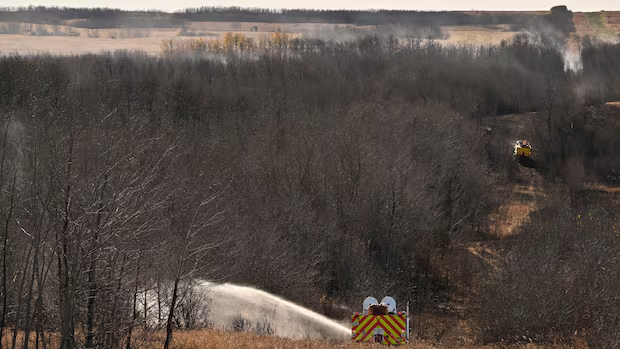
A perfect storm of weather conditions transformed a Saturday afternoon at CFB Wainwright into a catastrophic wildfire that claimed four soldiers' lives and severely injured dozens more, according to meteorologists and wildfire experts who have analysed the incident.
The tragedy unfolded as a powerful cold front swept across east-central Alberta, bringing with it a volatile combination of factors that fire experts say created what they call "extreme" conditions — conditions where fires don't just spread, they explode across the landscape.
Dangerous Weather Recipe
Before the cold front arrived, Wainwright experienced deceptively pleasant conditions. The morning brought sunny skies and temperatures climbing above 23 degrees Celsius. But lurking behind that pleasant facade was a dangerous meteorological setup that Environment Canada had flagged with yellow wind alerts across southern and central Alberta.
"Conditions were extreme," said Mike Flannigan, a professor of wildland fires at Thompson Rivers University in Kamloops, B.C., and director of Canada's fire weather outlook. "Things were dry. Any fires that started would have spread rapidly and would be intense — and that's pretty well what happened."
NASA satellite data confirmed fire was burning near the base by approximately 2 p.m. The Canadian Forest Fire Weather Index painted a grim picture: fire conditions across Alberta's prairies ranged from very high to extreme.
The Moment Everything Changed
Around 4 p.m., the cold front hit. In the span of minutes, temperatures plummeted roughly 10 degrees Celsius. More critically, wind direction shifted dramatically — a change that would prove fatal. The fire, which had been manageable moments before, was suddenly driven directly toward where soldiers were conducting a training exercise involving hand grenades and tactical section attacks.
Canadian Armed Forces Maj.-Gen. Wade Rutland, commander of the revitalized 1st Canadian Division, described the scene with stark clarity: troops reported the fire covered a kilometre in under a minute, appearing suddenly "right on top of them."
"This was uncommon, rapid, and I certainly hadn't seen anything like it," Rutland told reporters Sunday.
"Heavy winds shifted due to a cold front that was predicted alongside dry conditions" — Environment Canada meteorologist
Training Decisions Under Scrutiny
While early morning conditions had fallen within standard procedures for conducting training exercises — with wind gusts below 50 km/h — Rutland acknowledged that range control personnel were aware of a fire burning several hours before the tragedy and decided training could continue "for a certain amount of time."
Forecasters had predicted wind gusts exceeding 80 km/h would arrive later that afternoon, a critical detail that underscores how rapidly conditions deteriorated.
What Started the Fire Remains Unknown
The exact ignition source remains undetermined. With grenades being deployed on ranges and tactical exercises underway, multiple potential sources existed. Rutland noted the uncertainty, saying: "Quite frankly, it could have been any of that or none of it."
What fire experts agree on is that once ignited, the combination of dry vegetation, extremely low humidity, and accelerating winds created an environment where fire behaviour becomes unpredictable and devastating. The dry fuels accumulated during Alberta's recent drought conditions acted like kindling waiting for a spark.
A Rare Convergence
Flannigan and other meteorological experts emphasize that while Alberta experiences strong winds and dry conditions regularly, the specific convergence of factors that occurred Saturday — the precise timing of the cold front's arrival, the abrupt directional wind shift, the low humidity, and the accumulated dry fuel — created conditions rarely seen on the prairie.
The incident has reignited conversations about fire safety protocols during extreme weather events and how military training operations factor forecasted dangerous conditions into operational decisions.
This article is based on reporting from CBC Edmonton. Read the original story at CBC News.