


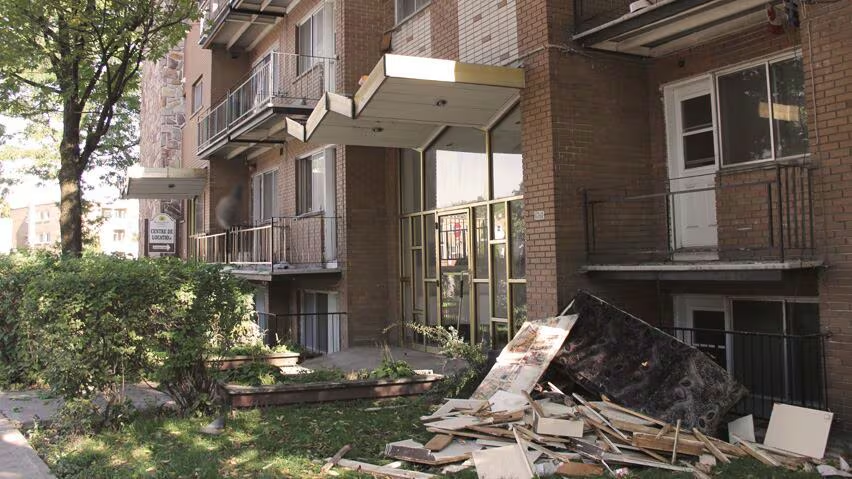
Quebec's social housing system is facing a mounting crisis, with nearly 21,500 units—roughly one-third of the province's entire affordable housing stock—now in states of significant disrepair.
The numbers tell a troubling story. Of approximately 74,000 social housing units across Quebec, housing advocates report that 34.2 per cent received poor-condition ratings (grades D or E) in 2026, down slightly from 43.9 per cent in 2023. While the percentage has improved, the actual repair costs have skyrocketed.
The Cost Crisis
Quebec's provincial government estimates it now needs more than $1.079 billion to renovate the remaining 1,445 buildings in poor condition—a staggering 25 per cent increase from the $859.5 million required in 2023. Housing advocates worry that current budgets will fall short as inflation continues to outpace renovation timelines.
Social housing in Quebec is owned and operated by the provincial government, with rents capped at just 25 per cent of household income—a critical lifeline for low-income renters. But the infrastructure supporting this system is deteriorating faster than it can be repaired.
Regional Disparities
The crisis is not evenly distributed across the province. Montreal and its northern suburb Laval face the most acute challenges. In Laval, 82.2 per cent of social housing units still require major renovations, with only 578 units considered in good condition. Montreal has shown improvement—dropping from 76 per cent in poor condition to 53 per cent by 2026—but remains deeply troubled.
More than half of Quebec's entire social housing stock is concentrated in the Montreal area, magnifying the impact of infrastructure failures on the city's most vulnerable residents.
In regions outside major urban centres, the picture is brighter. Rural and smaller-city social housing stock is generally in better condition, though areas like Montérégie, the Eastern Townships, and Lanaudière still report between 40 and 53 per cent of their units requiring serious renovations.
A Deteriorating Problem
Complicating matters further, some units that were rated in good condition (grades A through C) have deteriorated to poor condition ratings within the three-year window between 2023 and 2026—a sign that the housing crisis may be accelerating despite repair efforts.
The provincial government maintains that units with D or E grades remain safe and habitable, noting that ratings are based on estimated work costs over a five-year period rather than immediate safety concerns. Housing advocates, however, argue that without adequate funding, the gap between current conditions and acceptable standards will only widen.
This article is based on reporting from the Lethbridge Herald. Read the original story.