


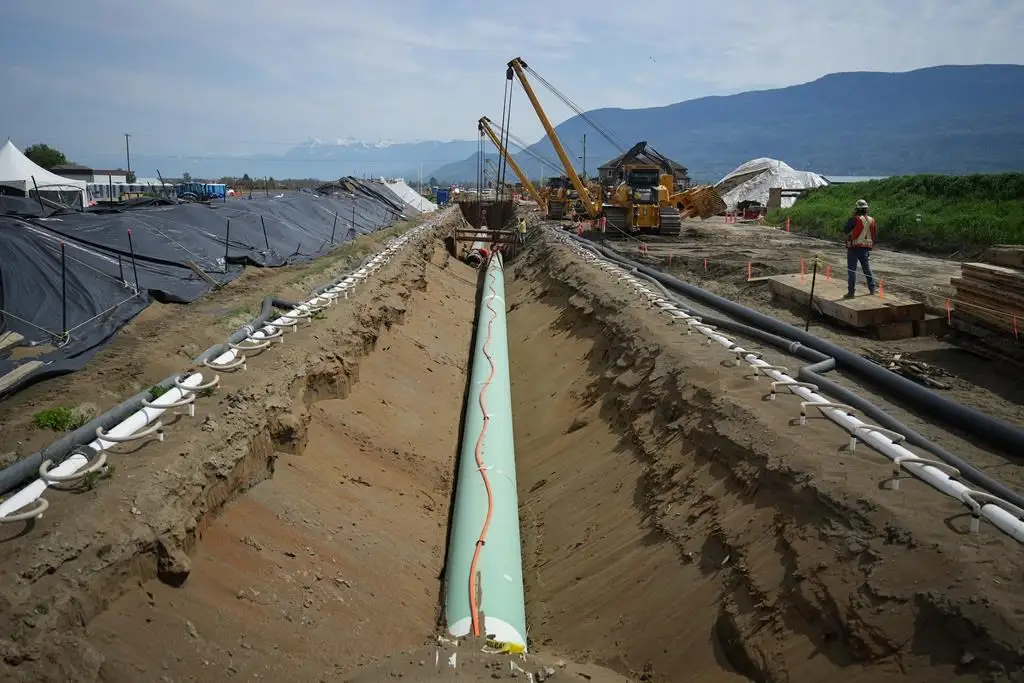
The success of the Trans Mountain pipeline expansion has reignited calls for additional energy infrastructure connecting Alberta's oilsands to coastal markets, with new research suggesting massive economic benefits await.
A report from the Montreal Economic Institute (MEI) found that Canada's improved access to non-U.S. markets has already delivered significant returns since Trans Mountain's completion in 2024. The price gap between light U.S. crude and heavy Alberta oil blends narrowed by 37.5 per cent, resulting in a US$16.7-billion revenue boost for the industry between June 2024 and November 2025.
"The reduction in the spread means that it is becoming possible to approach the full value of our resources, which helps Canadian firms, but also increases government revenues," said Gabriel Giguère, MEI's senior policy analyst.
The pipeline's impact on market diversification has been substantial. Before Trans Mountain's expansion, non-U.S. Canadian oil exports represented just three per cent of total exports. That figure jumped to 14 per cent in the fourth quarter of 2025.
New Pipeline Proposal Gains Momentum
The findings come as Alberta prepares a regulatory application for a new oil pipeline to northern British Columbia's coast, designed to transport up to one million barrels of oilsands crude daily to Asian markets.
The proposed project stems from a comprehensive energy agreement between Alberta and the federal government signed late last year. However, no private-sector company has yet committed to leading the initiative.
Premier Danielle Smith confirmed Wednesday that officials from both levels of government continue working through implementation details of the memorandum of understanding, which must be finalized by April 1.
Carbon Costs Offset by Export Premiums
A separate analysis from Clean Prosperity, a climate policy organization, suggests oilsands producers could easily absorb higher carbon pricing through increased export revenues.
The federal-Alberta agreement includes raising the minimum industrial carbon price to $130 per tonne from the current $95. Clean Prosperity's research indicates this increase would add between 81 cents and $3.75 per barrel in costs at major oilsands operations, up from the current range of 53 cents to $2.46 per barrel.
"Clean Prosperity's modelling shows that the federal-Alberta grand bargain is not just a climate breakthrough, but can also deliver a massive economic tailwind," said Benjamin Dachis, the group's vice-president of research and outreach.
The analysis examined carbon intensity at four major oilsands facilities: Cenovus Energy's Christina Lake operation, Suncor Energy's Firebag site, and Imperial Oil's Cold Lake and Kearl projects.
Infrastructure Urgency Highlighted
MEI's Giguère emphasized the need for streamlined regulatory processes to capitalize on global energy demand.
"The global demand for Canadian energy is very real, and new infrastructure has already demonstrated its benefits," he said. "It is urgent that governments remove the regulatory obstacles that obstruct the construction of new energy infrastructure."
For Calgary-area residents interested in energy sector developments and their economic impact, Calgary Prices offers comprehensive tracking of local fuel costs and market trends.
This article is based on reporting from Global Money and Jennifer Blackwood. Additional information sourced from Global Money.