


U.S. President Donald Trump made history on Wednesday by becoming the first sitting president to attend oral arguments at the Supreme Court of the United States, watching as justices sharply questioned his administration's effort to end automatic birthright citizenship for children born on American soil to parents without legal status.
Trump, dressed in a dark suit and red tie, arrived by motorcade from the White House and took a seat in the front row of the ornate public gallery. He departed shortly after Solicitor General John Sauer completed the government's opening presentation. The justices made no public acknowledgement of his presence in the courtroom.
The high court was hearing the Trump administration's appeal of a lower court ruling that blocked an executive order signed on the first day of Trump's second term. That order directed U.S. federal agencies to refuse recognition of citizenship for children born on American soil if neither parent holds U.S. citizenship or permanent residency status.
Justices Push Back on Administration's Arguments
Both conservative and liberal justices pressed Sauer hard on the administration's legal reasoning. Chief Justice John Roberts described the administration's interpretation of the 14th Amendment's phrase "subject to the jurisdiction thereof" as seeming "quirky" — a pointed rebuke from the court's top jurist.
Justice Brett Kavanaugh noted that what other nations do regarding birthright citizenship was likely legally irrelevant to the constitutional question before the court.
Sauer argued that "unrestricted birthright citizenship contradicts the practice of the overwhelming majority of modern nations." He added that in the administration's view, the current policy "demeans the priceless and profound gift of American citizenship" and acts as "a powerful pull factor for illegal immigration."
"It rewards illegal aliens who not only violate the immigration laws but also jump in front of those who follow the rules."
— Solicitor General John Sauer, representing the Trump administration
Notably, Canada is among roughly three dozen countries — nearly all located in the Americas — that maintain unconditional birthright citizenship, according to data from the Global Citizenship Observatory at the European University Institute's Robert Schuman Centre for Advanced Studies.
The 14th Amendment at the Centre of the Dispute
The constitutional provision at issue, known as the Citizenship Clause of the 14th Amendment, reads: "All persons born or naturalized in the United States, and subject to the jurisdiction thereof, are citizens of the United States and of the state wherein they reside."
Courts have long interpreted this language as guaranteeing citizenship to virtually all children born on U.S. soil, with narrow historical exceptions such as children of foreign diplomats or members of an enemy occupying force. A federal court in New Hampshire had already found Trump's executive order violated both the 14th Amendment and federal law codifying birthright citizenship rights.
The administration has argued the policy encourages illegal immigration and so-called "birth tourism," in which foreign nationals travel to the United States specifically to give birth and secure citizenship for their children.
Protests Outside the Courthouse
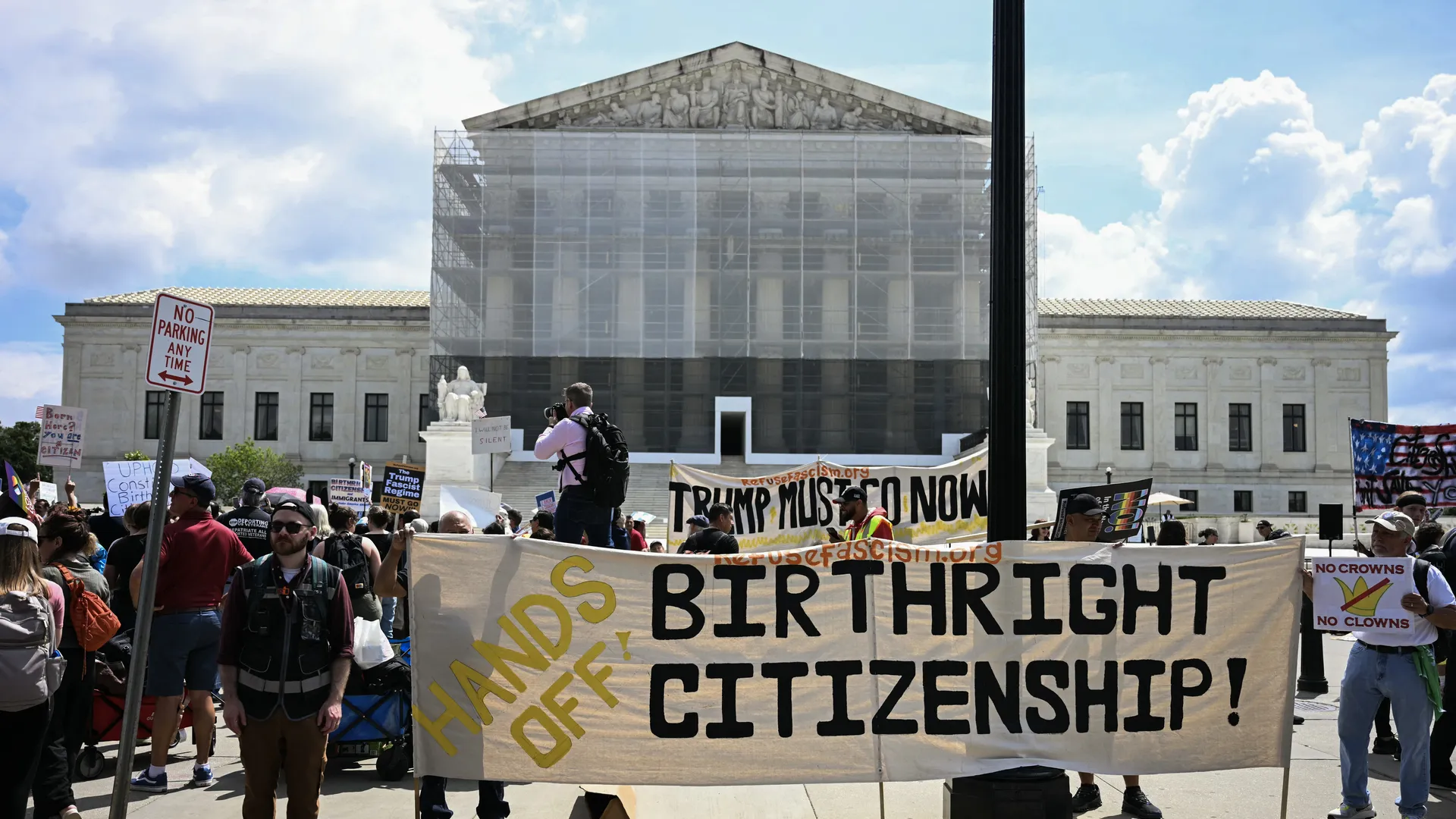
Groups of demonstrators gathered on the steps and surrounding area of the Supreme Court building, carrying signs reading "Hands Off Birthright Citizenship," "Trump Must Go Now," and "Don't Let Trump Change the Constitution." The case has drawn significant public attention as one of the most consequential constitutional challenges of Trump's second term.
The oral arguments also took place against a backdrop of escalating tension between the Trump White House and the federal judiciary. Trump has publicly attacked judges who have ruled against his administration, recently calling conservative justices Neil Gorsuch and Amy Coney Barrett "an embarrassment to their families" after an unfavourable Supreme Court ruling on tariffs. Chief Justice Roberts has publicly rebuked personal attacks on judges on at least two occasions since last year, amid a reported rise in threats against members of the judiciary.
A ruling from the Supreme Court is expected in the coming months and could fundamentally reshape U.S. citizenship law.
Source: CBC World. This article is based on reporting by Thomson Reuters via CBC News.