


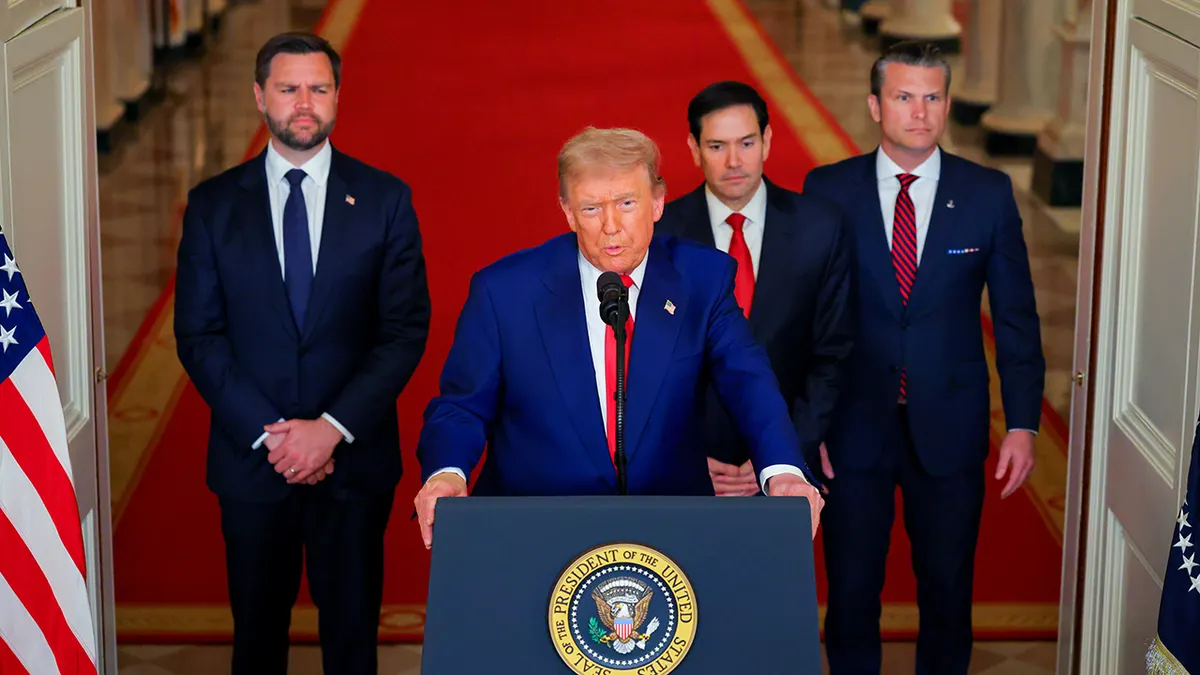
U.S. President Donald Trump took to prime-time network television Wednesday night to make his case for continuing — and intensifying — a war against Iran that he has repeatedly suggested is nearly over.
In his first live national address since the conflict began more than a month ago, Trump told Americans that military objectives were close to being achieved, yet pledged to escalate strikes dramatically in the weeks ahead.
"We are on track to complete all of America's military objectives shortly, very shortly," Trump said. "We are going to hit them extremely hard over the next two to three weeks. We're going to bring them back to the stone ages where they belong."
The contradictory message — victory is near, but the bombing must intensify — left analysts puzzled and deeply concerned about what comes next.
Analysts See Escalation, Not an Exit
Brett McGurk, a former U.S. National Security Council adviser on Middle East affairs, said he expected a wind-down speech. What he heard was something far more alarming.
"I thought we might hear a de-escalatory speech, that we're going to wrap this up in a couple weeks," McGurk told CNN following the address. "I actually heard something quite different. I think this war is going to continue for some time — that's what I heard."
Janice Stein, founding director of the Munk School of Global Affairs and Public Policy in Toronto, told CBC News chief correspondent Adrienne Arsenault that the speech left her astonished — particularly Trump's apparent willingness to signal an end to the conflict while simultaneously threatening to escalate it.
"When you're trying to coerce your adversary to come to the table and do what Donald Trump says he's expert at — the art of the deal — you never signal openly to them that the war is coming to an end. Because if you do that, why wouldn't they just wait you out?" Stein said.
A Boastful Accounting of Military Gains
Much of Trump's roughly 20-minute address was devoted to cataloguing what he described as the near-total destruction of Iran's military capacity. He claimed Iran's navy had been eliminated, its air force reduced to ruins, its weapons factories demolished, the Islamic Revolutionary Guard Corps decimated, and most of its leadership killed.
"Never in the history of warfare has an enemy suffered such clear and devastating large-scale losses in a matter of weeks," Trump declared.
Despite the sweeping claims, Iran continued to launch strikes across the region even as Trump spoke, and Israel maintained its own offensive operations against Iranian targets — suggesting the conflict remains far from resolved.
Diplomacy Barely Gets a Mention
In the entire 20-minute address, Trump referenced the possibility of negotiations with Tehran only once — a detail that analysts said spoke volumes about the administration's true intentions. With diplomatic off-ramps largely absent from the speech, the path forward appears to be more bombs, not a bargaining table.
For Canadians watching the conflict unfold, the implications are significant. Canada shares deep economic and security ties with the United States, and a prolonged Middle East war carries risks for global energy markets, international trade, and regional stability affecting Canadian interests abroad.
Source: CBC World. This article is based on reporting by CBC News.