


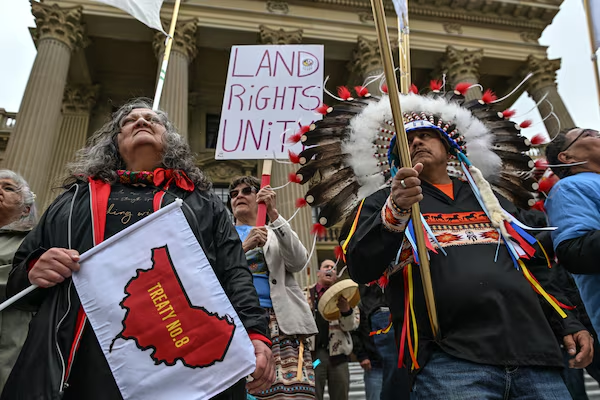
An Alberta court's decision to quash a citizen-led separation referendum this week has thrust Indigenous treaty rights to the forefront of Alberta's independence movement—and legal experts say the implications could reshape the entire conversation around provincial autonomy.
Justice Shaina Leonard ruled that Elections Alberta's chief electoral officer failed to properly consider a previous court decision establishing that Alberta separation would violate treaty rights held by First Nations. Even more significantly, Leonard found the provincial government breached its constitutional duty to consult with Indigenous communities before approving the petition.
Now, with Premier Danielle Smith and the Stay Free Alberta organization vowing to appeal, a University of Alberta expert is sounding a reality check: the courts are taking these obligations seriously, and the separatist movement needs to do the same.
Treaty Rights Take Centre Stage
Matthew Wildcat, director of Indigenous governance at the University of Alberta's faculty of Native studies, says the court's decision signals an important shift in how Canadian law treats Indigenous sovereignty.
"It was a really hopeful sign that the Canadian legal system is taking treaty rights seriously in this instance," Wildcat told CBC's Edmonton AM on Friday.
The separation movement, he argues, has historically treated Indigenous concerns as secondary rather than foundational to independence efforts. "Although it does pay some lip service to Aboriginal and treaty rights and to First Nations themselves, that overall it thinks those questions can be dealt with on a secondary basis rather than have to be prioritized," Wildcat explained.
The Consultation Question
The Alberta government's failure to consult First Nations before approving the referendum petition represents what Wildcat calls a significant legal weakness. Two judges have now found that no proper consultation occurred—a pattern that suggests the government's approach is legally vulnerable.
"I think the finding will stand," Wildcat said of Justice Leonard's consultation ruling.
The government has argued that consultation requirements apply mainly to executive policy implementation rather than legislative changes. But courts are increasingly questioning whether that distinction actually holds in cases affecting Indigenous peoples.
What Comes Next?
As the appeals process unfolds, one thing is clear: any path to an Alberta referendum now must grapple with decades of treaty obligations that predate the province itself. Separatist organizers can no longer defer these conversations to after a vote—courts are demanding they happen first.
For Calgary residents and Albertans watching this debate unfold, the legal battle highlights a fundamental question: can Alberta's independence movement succeed without addressing the rights of those whose ancestors signed the treaties that shaped this province?
This article was adapted from reporting by CBC Calgary and analysis provided by University of Alberta expert Matthew Wildcat. Read the original CBC News article.