


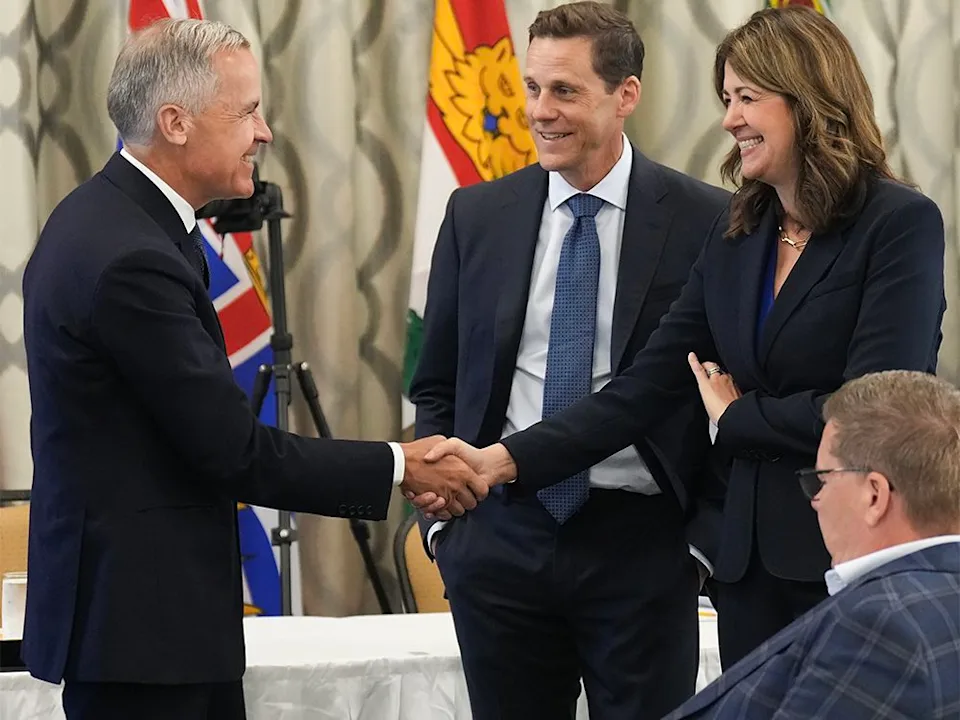
Alberta Premier Danielle Smith is banking on a swift resolution to months of tense negotiations with Ottawa, telling reporters Friday that a landmark energy agreement could be finalized within days rather than weeks.
Smith's optimism marks a dramatic shift in tone. Meeting with Prime Minister Mark Carney in the nation's capital, the premier revealed she had moved from saying a pipeline deal "if" it gets signed to saying "when" it gets signed — a telling change of language that underscores renewed confidence in the negotiations.
"After talking through some of the areas that we found were in disagreement, my level of confidence has improved significantly," Smith said following her private discussion with Carney.
The stakes could hardly be higher. With separatist activists pushing for a provincial referendum and tensions simmering over energy policy, Smith is betting that a successful federal-provincial agreement will demonstrate to Albertans that the Canadian system can deliver results for the province.
The Carbon Price Sticking Point
While both leaders expressed optimism, significant details remain unresolved. Smith identified the timeline for implementing a $130-per-tonne industrial carbon price as a key remaining flashpoint — an issue that has sat at the centre of discussions throughout the negotiation process.
The memorandum of understanding outlines several conditions before a new bitumen pipeline can be approved, including strict requirements for carbon capture and storage. The original April 1 deadline for completing these conditions has already been pushed to July 1, adding pressure to reach a final agreement soon.
"If we're going to move forward with that MOU, I hope it happens in the next number of days, because I think in Alberta there does need to be a demonstration that Canada can work," Smith said before meeting with Carney.
Global Energy Markets Shift the Equation
Prime Minister Carney has previously signalled that a new pipeline is now "more probable than possible," citing upheaval in global energy markets triggered by international conflict. During Friday's photo opportunity, Carney struck a conciliatory note without directly addressing pipeline specifics or Alberta's separatist movement.
"We're working to make Canada work better for Albertans and for all Canadians. And when Canada works well, it's good for the world," Carney stated.
Smith indicated that once a deal is finalized, she will be able to publicly discuss remaining gaps between the two governments — suggesting her current discretion is tied to ongoing negotiations rather than fundamental disagreement over the deal's direction.
Separatism and the Need for a Win
The timing of this breakthrough cannot be separated from Alberta's political climate. Earlier this week, organizers behind a separatist petition submitted more than 300,000 signatures to Elections Alberta. However, a court order has temporarily blocked verification of those signatures while a judge considers a legal challenge from Alberta First Nations, who argue the petition process violates treaty rights.
For Smith, delivering a major infrastructure and economic agreement with Ottawa could serve as a powerful counterargument to separation sentiment — evidence that Alberta's interests can be protected within Confederation.
"There does need to be a demonstration that Canada can work," Smith emphasized, her words carrying weight beyond mere policy discussion.
This article is based on reporting from CBC Calgary. For more information on this developing story, visit CBC News.