


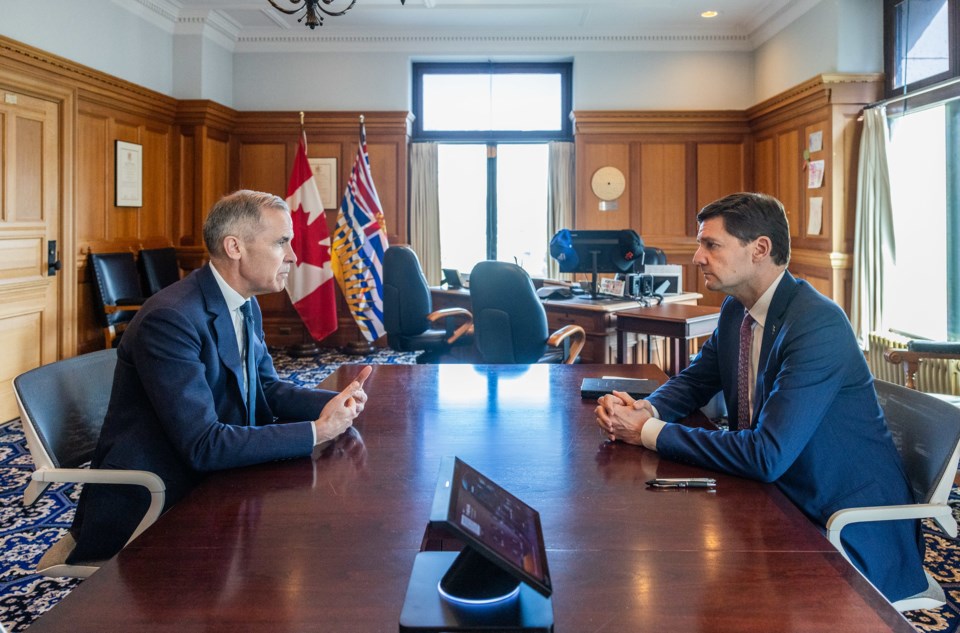
British Columbia and Ottawa are locked in a tense standoff over trade, pipelines, and alcohol—with Prime Minister Mark Carney now personally reassuring Premier David Eby that rumours of a controversial oil pipeline route through southern B.C. didn't originate from his government.
The two leaders spoke by phone Thursday as tensions over Canada-U.S.-Mexico Agreement (CUSMA) renegotiations heat up. At the centre of the dispute: B.C.'s ban on American liquor, which is driving U.S. frustration, and unconfirmed reports suggesting Ottawa might be considering a southern pipeline corridor from Alberta—a proposal that would ignite fresh conflict in British Columbia.
"There's just not a world where we could support that," Eby told reporters, referring to any pipeline route through southern B.C.
Earlier this week, the Globe and Mail reported that two unnamed federal sources suggested Ottawa was leaning toward a southern path for the pipeline. The revelation sparked immediate alarm in Victoria. Eby stressed that Alberta Premier Danielle Smith hasn't even broached the idea with him, and the only route he's aware of remains the contentious North Coast option—which B.C. and First Nations have fiercely opposed.
But the pipeline chatter is only part of a larger trade war simmering between Canada and the United States. B.C.'s decision to pull American liquor from provincial store shelves has drawn White House complaints and industry backlash, particularly from hospitality businesses that depend on cross-border sales.
Eby made clear Thursday that B.C. isn't backing down. "The prime minister understands clearly and I certainly underlined that this is a provincial decision that we will not be putting liquor back on the shelves until B.C.'s trade issues are addressed," he said. "The reality is, British Columbians are pissed off about our industry being attacked, our families losing jobs for absolutely no reason."
From Ottawa, Carney countered that Canada has plenty of grievances of its own. He pointed to American tariffs—50 per cent on steel and aluminum, 25 per cent on automobiles, and sweeping duties on forest products—as violations of the existing trade deal that must be addressed in negotiations.
"You know what's an irritant? A 50 per cent tariff on steel and aluminum, 25 per cent on automobiles, all of the tariffs on forest products," Carney told reporters. "Those are more than irritants. Those are violations of our trade deal, OK?"
B.C. Minister of Forests Ravi Parmar welcomed Carney's inclusion of softwood lumber in the federal pushback. "We're certainly heartened to hear that we are going to continue to make the case to Ottawa that for British Columbia, in order for us to feel successful in these CUSMA renegotiations, we have to deal with the challenge of softwood," Parmar said.
The hospitality sector, however, is growing impatient. Ian Tostenson, president and CEO of the B.C. Restaurant and Food Services Association, questioned whether the liquor ban's economic toll on restaurants and bars justifies the leverage Eby believes it provides. He argued that wholesale customers should at least be permitted to purchase American liquor, even if B.C. keeps it off provincial store shelves.
"I think [Eby] feels this is leverage, and there's some big things that have been hurt in the B.C. economy," Tostenson said.
The standoff underscores the delicate balance Canadian leaders must strike in trade negotiations—balancing provincial interests, industry concerns, and federal strategy as tensions with Washington continue to escalate.
This article is based on reporting from CBC Politics.