


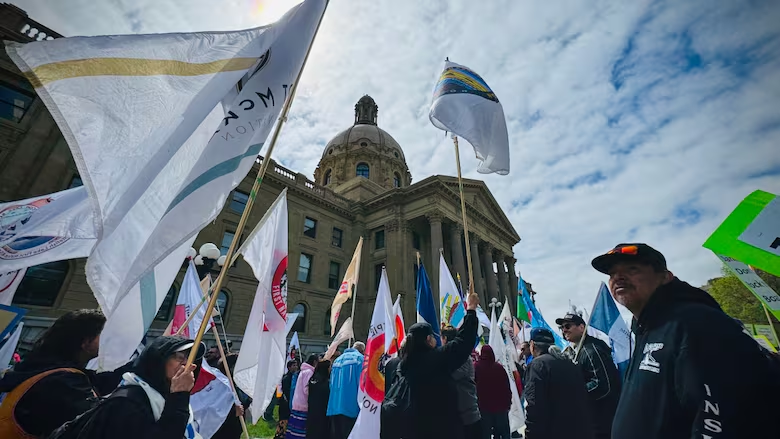
A dramatic court challenge unfolding in Edmonton this week could reshape the entire legal landscape around Alberta separatism—and potentially affect Quebec's future independence aspirations as well.
The stakes go far beyond blocking a petition drive. First Nations lawyers are arguing that Alberta cannot legally separate from Canada without devastating Indigenous treaty rights that stretch across provincial and international boundaries.
The Treaty Question
Sturgeon Lake Cree Nation and the Athabasca Chipewyan First Nation (ACFN) presented a compelling constitutional argument before Justice Shaina Leonard: if Alberta becomes independent, it would instantly create an international border through the middle of Treaty 8 territory—land where Indigenous peoples have hunted, fished, and trapped freely for generations.
"Any constraint on those activities by an international border would violate those [rights]," Kevin Hille, lawyer for ACFN, told the court this week.
Treaty 8 spans Alberta, Saskatchewan, the Northwest Territories, and British Columbia. For the Blackfoot Confederacy and other First Nations groups involved in the case, provincial separation isn't just a political question—it's a constitutional violation waiting to happen.
The Separatist Response
Lawyers for Stay Free Alberta and the provincial government pushed back hard. They argued that signature gathering for a referendum doesn't trigger any violation of Indigenous rights, and that consultation duties don't kick in until much later—if a separation actually occurs.
"A vote does not in and of itself change the status of those rights," argued Jennifer Keliher, representing the Alberta government.
Jeffrey Rath, representing the separatist movement, was blunt: "Nobody's rights have been infringed, not even the tiniest little bit, by the gathering of signatures."
A Court Pause—But the Real Battle Looms
Justice Leonard didn't rule on the full constitutional question this week, but she did something significant: she paused Elections Alberta's certification process for the more than 177,800 signatures that Stay Free claims to have collected. The deadline for submission was May 2.
In her decision, Leonard acknowledged that First Nations "have provided evidence of harm from lack of consultation and harm to treaty relationships." She granted a one-month stay to allow her to fully consider the broader constitutional issues at play.
The judge also noted something crucial: Indigenous rights law has evolved considerably since 1998, when Canada's Supreme Court last addressed provincial secession in the Quebec separation reference.
Why This Matters Beyond Alberta
If Canadian courts rule that provincial independence violates First Nations treaty rights, the implications ripple across the country. Quebec separation debates would face the same constitutional roadblocks. The 1995 Quebec referendum nearly split the country—and First Nations treaty arguments weren't prominent in that debate. They could be now.
The Supreme Court's 1998 decision established that unilateral separation is illegal, but a clear referendum victory would require Canada to negotiate. That ruling predates modern understandings of Indigenous rights and the constitutional obligations created by Section 35 of the Canadian Constitution, which guarantees consultation on constitutional changes affecting First Nations.
What Happens Next
The court battle continues. Justice Leonard will eventually rule on whether the entire separation petition process should be blocked on constitutional grounds—a decision that could redefine what Alberta separatism can legally do.
For now, the court has spoken: Indigenous treaty rights matter enough to pause democracy's gears. That's a seismic shift in how Canadian courts view provincial independence.
This article is based on reporting from CBC Edmonton on the First Nations court challenge to Alberta's separatist petition drive.