


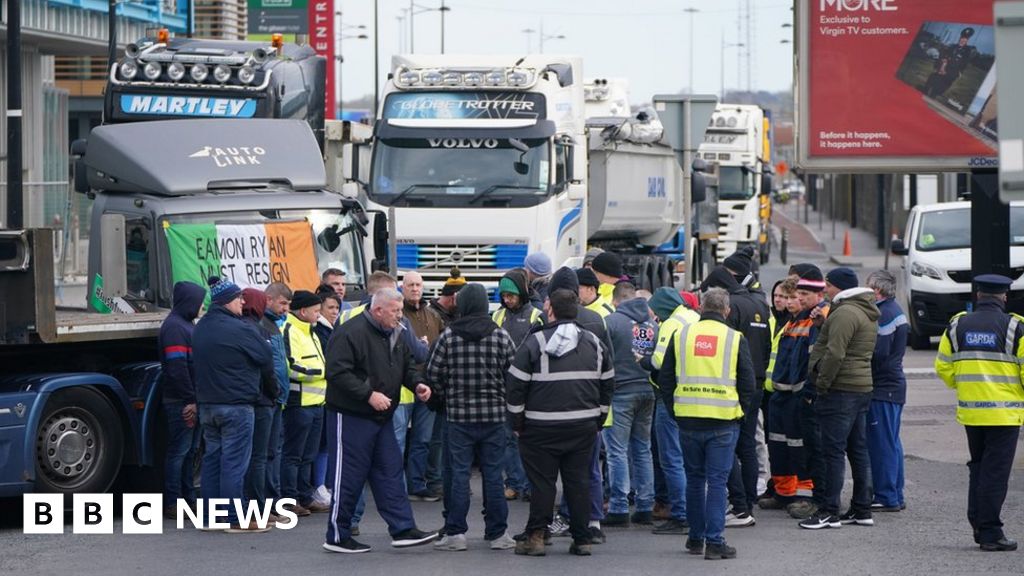
Ireland is facing a critical fuel shortage as coordinated blockades by truckers, farmers, and taxi operators continue into their fifth day, leaving more than one-third of the country's service stations running dry and threatening to cripple essential services across the nation.
The escalating standoff centres on demands for government intervention on fuel prices, with protesters occupying vital fuel depots, ports, and major highways—including sections of Dublin's primary ring road. The demonstrations have grown substantially since Tuesday as word spread through social media, drawing support from transport and agricultural sectors struggling with skyrocketing energy costs.
Irish police took enforcement action Saturday to reopen the nation's only oil refinery in County Cork after arresting protesters who had maintained illegal blockades. Police Commissioner Justin Kelly defended the crackdown, stating that the demonstrations posed a genuine threat to public safety by potentially hampering emergency response times for paramedics and firefighters.
"These are blockades. They are not a legitimate form of protest," Kelly said. "We gave the blockaders fair warning that we were moving to enforcement and they chose to ignore it and continue to hold the country to ransom."
Government negotiators reported progress in talks Saturday aimed at resolving the dispute. Ger Hyland, president of the Irish Road Haulage Association and acting representative for some protest groups, acknowledged the genuine financial desperation driving the action.
"They're hard-working business people, and they're just trying to survive and keep their business afloat," Hyland said of the protesters.
Plumber Paddy Murray, who joined blockades at the port in Rosslare, articulated the frustration driving ordinary workers to take such drastic action. Speaking to national broadcaster RTE, Murray said working-class Canadians have subsidized government through taxes for decades and deserve support during cost-of-living crises.
The protests have caught government officials off guard. Irish Prime Minister Micheál Martin said Friday that the country risks turning away fuel tankers at ports and potentially losing its oil supply entirely—a scenario he described as "unconscionable" and "illogical" given that global price spikes stem from Middle East geopolitical tensions beyond Ireland's control.
However, the human cost of fuel inflation on small businesses and working families has proven more compelling to protesters than the government's macroeconomic arguments. Taxi operators, bus drivers, and independent tradespeople face impossible margins when fuel expenses consume an outsized portion of operating costs.
Service station fuel availability is deteriorating rapidly. According to Fuels for Ireland chief executive Kevin McPartlan, more than one-third of Ireland's 1,500 service stations had depleted their fuel supplies by Saturday, with numbers expected to spike dramatically if blockades persist. Reopening the Whitegate refinery is a critical first step toward restoring supply.
The standoff reflects broader tensions across developed economies where working-class and small-business populations feel economically squeezed by global market forces they cannot control or influence through traditional political channels.
This article is based on reporting from CBC World.