


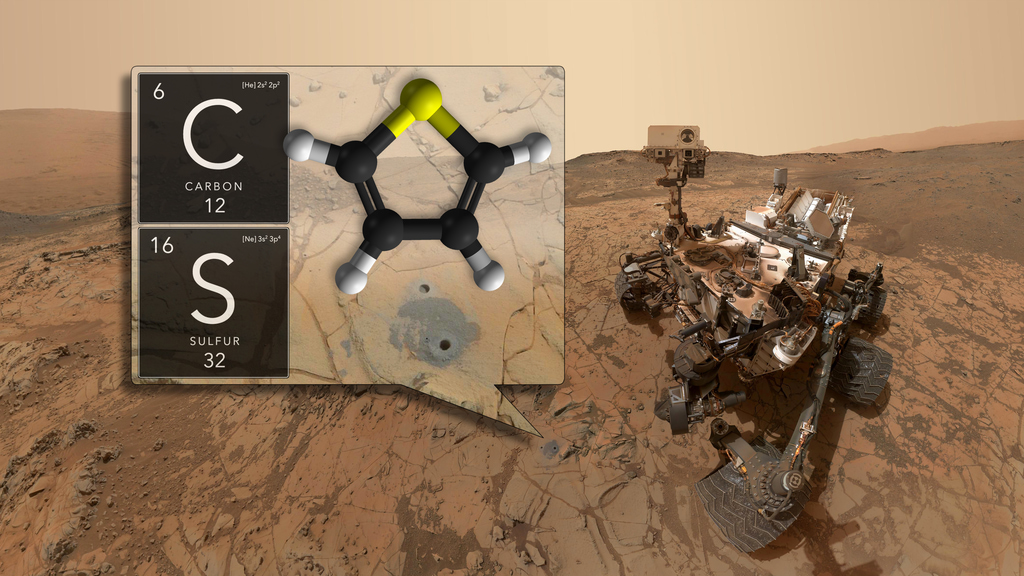
NASA's Curiosity rover has made a groundbreaking discovery that brings scientists closer to answering one of humanity's most profound questions: Was Mars ever home to life?
The six-wheeled rover has identified seven organic compounds in rock samples collected from a dried lakebed near Mars's equator—five of which have never been detected on the Red Planet before. The findings, published Tuesday in the journal Nature Communications, represent a significant milestone in humanity's quest to understand Mars's ancient past.
New Molecules Point to DNA Precursors
Even more intriguing, the rover's instruments detected hints of another organic compound with a structure similar to DNA precursors—the building blocks of genetic material that carries life's instructions on Earth.
"To be clear, we have not found evidence for life with this study, but we're further refining the building-block molecules that were present on Mars," said astrobiologist Amy Williams of the University of Florida, the study's lead author and member of the Curiosity scientific team.
"Mars environments were habitable in the ancient past and had the ingredients for life as we know it."
A Habitable World 3.5 Billion Years Ago
The rock samples analysed by Curiosity date back at least 3.5 billion years—a period when Mars was dramatically different from the cold, barren desert it is today. Early Mars was warmer, wetter, and far more conducive to supporting life. The sediment containing these organic compounds was laid down by flowing water, providing tantalizing clues about conditions that could have sustained microbial life.
"We cannot yet say that Mars ever harboured life, but our findings further support the evidence that Mars was a habitable world around the time that life on Earth originated," Williams explained.
Why Clay Minerals Matter
Curiosity conducted the analysis in 2020 within Glen Torridon, a region of the Gale crater rich in clay minerals. Scientists believe clay is particularly valuable for preserving organic molecules—making it an ideal location to search for chemical evidence of ancient life.
The rover's Sample Analysis at Mars (SAM) instrument drilled into bedrock at a site named Mary Anning, honouring the renowned 19th-century English paleontologist. The powdered rock was then treated with a chemical that breaks down complex organic matter into smaller, detectable pieces.
The Bigger Picture
To date, scientists have identified dozens of organic compounds on Mars—all of which could theoretically have formed through non-biological chemical processes. However, each new discovery adds another piece to the puzzle of Mars's past.
Bringing definitive proof of ancient Martian life would require transporting rock samples back to Earth for analysis with sophisticated laboratory equipment. NASA's Perseverance rover recently identified features in another crater that may have been created through chemical reactions involving microbes—another promising lead in the search.
This article is based on reporting from CBC Tech and NASA's official announcements regarding the Curiosity rover's latest findings on Mars.