


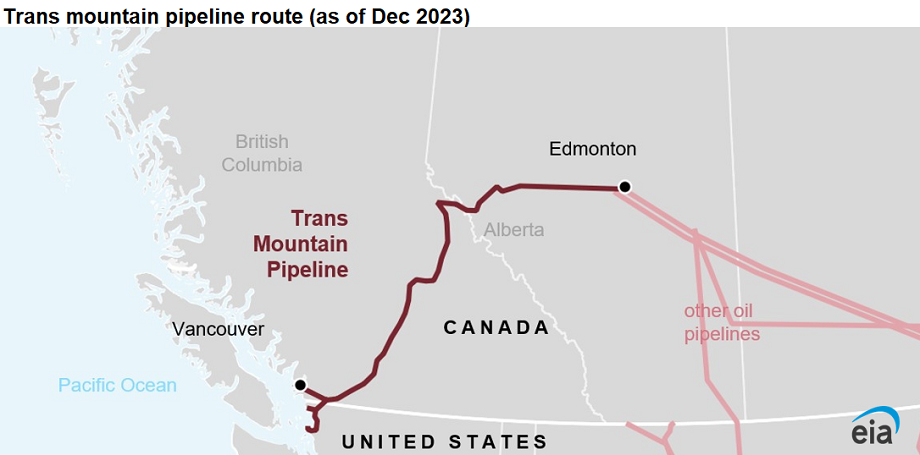
The Trans Mountain Pipeline has reached full operational capacity years ahead of initial projections, driven by surging global demand for Canadian crude oil amid escalating tensions in the Middle East, federal energy officials confirmed Friday.
The expanded pipeline system, which began commercial operations in May 2024, is now transporting 890,000 barrels per day from Alberta's oilsands to the Westridge Marine Terminal in Burnaby, B.C. — its maximum designed capacity. Industry analysts had not expected full utilization until 2028 at the earliest.
"The geopolitical instability in the Middle East has fundamentally altered global energy markets," said Trans Mountain Corporation CEO Dawn Farrell during a press conference in Calgary. "International buyers are actively seeking stable, reliable energy sources, and Canada is uniquely positioned to meet that demand."
The pipeline's rapid capacity utilization comes as ongoing conflicts in the region have disrupted traditional oil supply chains, prompting Asian refineries to pivot toward North American crude sources. Japan, South Korea, and India have emerged as the primary destinations for Canadian oil shipped through the expanded Trans Mountain system.
Calgary-based energy economist Dr. Sarah Mitchell noted that the accelerated timeline reflects broader shifts in global energy security priorities. "What we're seeing is a structural change in how international markets view energy reliability," Mitchell explained. "Canadian oil is increasingly viewed as a premium product due to its political stability and consistent supply."
The pipeline's success has generated significant economic benefits for Alberta and British Columbia. Provincial officials estimate the project is contributing approximately $2.8 billion annually to Canada's GDP, with downstream processing and marine terminal operations creating thousands of jobs in the Lower Mainland.
However, environmental groups continue to express concerns about the pipeline's climate impact. "While we understand the economic pressures, reaching full capacity this quickly highlights the urgent need for accelerated investment in renewable energy alternatives," said Environmental Defence Canada spokesperson Jennifer Martinez.
Trans Mountain Corporation reported that the expanded system has maintained a 99.7 per cent operational reliability rate since beginning commercial operations, with no significant environmental incidents. The company has invested heavily in monitoring systems and emergency response capabilities along the 1,150-kilometre route.
Federal Natural Resources Minister Jonathan Wilkinson emphasized that the pipeline's performance demonstrates Canada's ability to be a reliable energy partner during global crises. "This infrastructure investment is proving its value not just economically, but strategically for Canada's position in international markets," Wilkinson stated.
Looking ahead, Trans Mountain Corporation is exploring potential expansion opportunities, though any new capacity additions would require extensive regulatory review and stakeholder consultation. The company indicated that preliminary feasibility studies for additional pipeline capacity could begin as early as late 2026.
Energy market analysts predict sustained high utilization rates for the pipeline system, with long-term contracts already secured through 2029. The rapid capacity achievement has also prompted renewed interest in other Canadian pipeline projects that had been shelved due to market uncertainty.